The Minnesota Nutrient Reduction Strategy (NRS) compiles the latest science, research, and data and recommends the most effective strategies to reduce nutrients in our waters from both point and nonpoint sources. Reducing excess nutrients in waters — nitrogen, especially nitrate, and phosphorous — will improve water quality. The strategy serves as a framework, outlining how voluntary and regulatory actions can reduce nutrient pollution to meet long-term goals. When nutrient levels exceed natural conditions, they can cause excessive algae growth, low levels of oxygen, toxicity to aquatic life, and unhealthy drinking water. Reductions in Minnesota’s nitrogen and phosphorus pollution are needed to reach our in-state water quality goals and the goals that aim to restore the Gulf, Lake Winnipeg, and Lake Superior.
The Minnesota NRS contains important information for local governments, soil and water conservation districts, advocacy groups, and agencies at the state and federal levels.

2025 Minnesota Nutrient Reduction Strategy
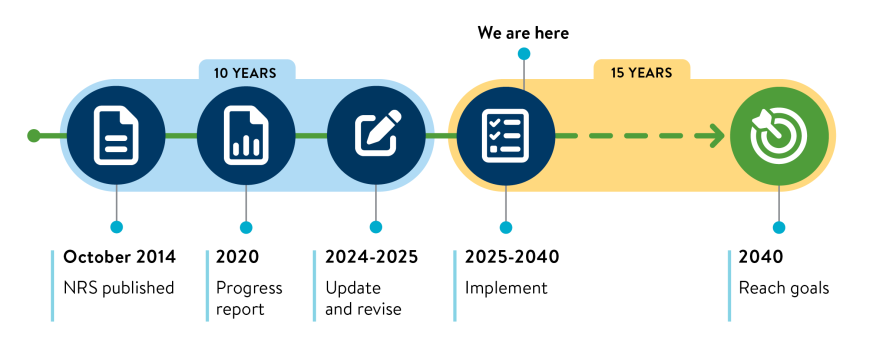
The 2025 Minnesota Nutrient Reduction Strategy is a comprehensive revision of the 2014 original. It highlights measurable progress across the state, suggests options to reduce excess nutrients, and introduces new tools tailored to support Minnesota’s watershed approach to improving water quality.
Supports local watershed work
Implementation of the 2025 Minnesota NRS aligns with the Minnesota Water Management Framework and supports local watershed work. Several tools were built for planning and tracking the impact of efforts to reduce nitrogen and phosphorus in Minnesota waters and support NRS implementation through Minnesota’s watershed restoration and protection strategies (WRAPS) and One Watershed, One Plan (1W1P) programs. This training video demonstrates how to use these tools and ways local watershed professionals can leverage the 2025 Minnesota NRS.

Download the 2025 Minnesota NRS
The 2025 strategy contains an executive summary and eight chapters, each examining a topic in depth. The underlying research, data, and analyses are captured in the appendices and organized by topic.
Appendices by chapter
- final expected in 2026
Public comments and outreach
During the 2023-25 update process, significant public outreach engaged more than 4,200 people. In summer 2025, a public comment period generated 62 written comments on the draft strategy and appendices.
As teams of scientists from state, federal, and regional agencies worked on the 2025 Minnesota NRS, they took part in many webinars, panel discussions and presentations; some of them were recorded and are posted below.
- June 2024 - Kickoff for Minnesota NRS update
- August 2024 - River nutrient levels: What’s in the water?
- March 2025 – Interactive water quality maps: Tracking progress
- July 15, 2025 - Overview of draft 2025 update
- July 24, 2025 - Q&A on the draft 2025 update
Tracking progress
Adoption of best management practices (BMP) to reduce excess nutrients is tracked through state and federal government programs; the links below lead to interactive reports. Additional best management practice adoption occurs outside of government programs.
- Best management practice adoption summary — statewide, large scale (2004-2023)
- Best management practice adoption summary — local level, watershed scale (2004-2023)
- BMP effects estimator tool (BEET) planner - Tool to estimate nutrient reduction in rivers and streams from future best management practice adoption scenarios
- BMP effects estimator tool (BEET) tracker - Tool to estimate nutrient reduction in rivers and streams from existing best management practices and progress towards meeting reduction goals set by the Minnesota Nutrient Reduction Strategy
Urban wastewater nutrient discharge: Annual pollutant load trends and effluent concentrations and flows from wastewater treatment plants are tracked by facility and major watershed for total nitrogen and phosphorus as well other constituents.
River nutrient monitoring: The amount of nutrients in water is measured many times throughout the year. Each year, the MPCA updates river nutrient trends and river monitoring results on the most recently calculated loads and concentrations.
- Nutrient trends over time at MPCA-monitored sites (2001-2022)
- Daily and annual nutrient measurements at MPCA-monitored sites (approx. 2009-2021)
Minnesota NRS publications
Five-year progress report
This 2020 report by Minnesota state agencies details implementation of the Minnesota NRS from 2014 to 2019 and progress in three key areas: water quality trends, statewide programs to improve waters, and urban and rural practices adopted to reduce nutrients.
2014 Minnesota NRS
- (2014)