What can 67,000 pounds of trash tell us about Minnesota?
Quite a lot, it turns out, including how Minnesotans can keep more of that trash out of landfills. A new report from the Minnesota Pollution Control Agency (MPCA) details not just what’s in the state’s trash but also how to better manage it.
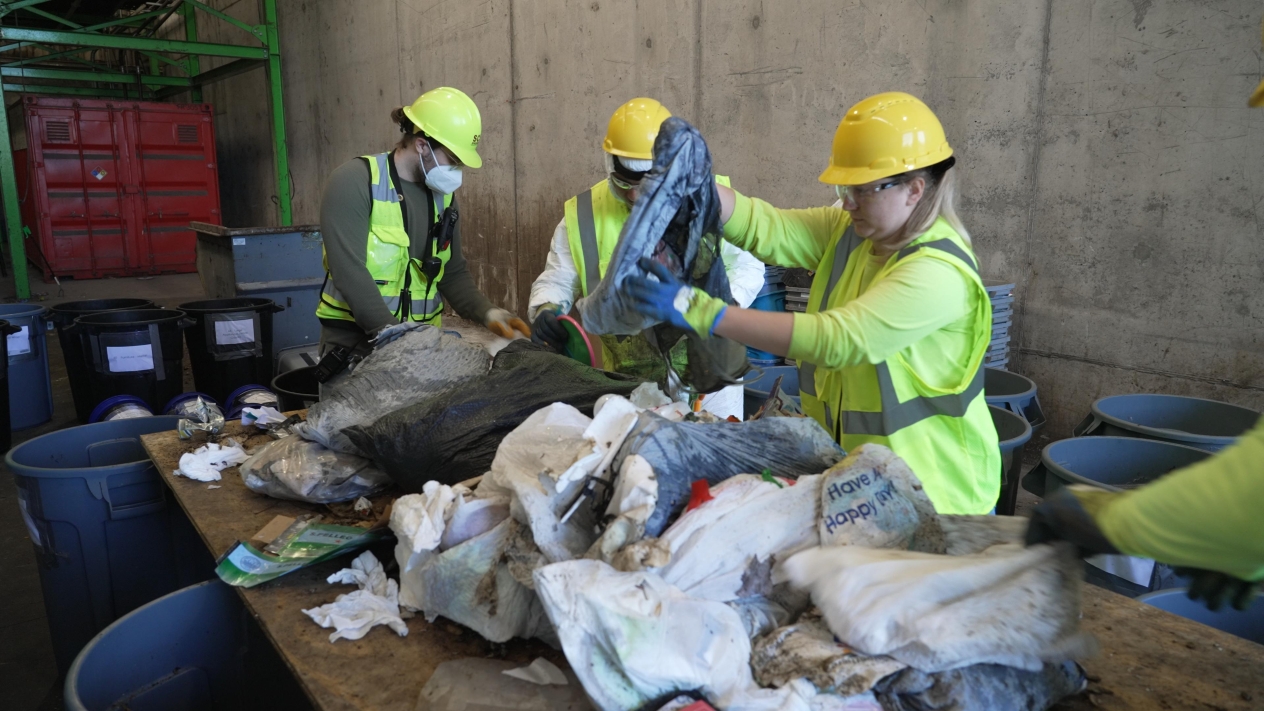
During fall 2025 and winter 2026, researchers working off an EPA Solid Waste Infrastructure for Recycling grant went through more than 67,000 pounds of waste collected at six solid waste facilities across Minnesota. They sorted the waste into dozens of different bins, documenting everything from food waste and packaging to batteries and other materials that end up in the trash.
The goal wasn’t simply to find out how much Minnesotans throw away. We already know that amount: about 6.4 million tons per year, according to the most recent SCORE report. The SCORE report is an annual measurement of total municipal solid waste generated in the state that is produced by the MPCA and Governor's Select Committee on Recycling and the Environment (SCORE). Rather, the study was designed to better understand what makes up Minnesota’s waste stream — and where there may be opportunities to prevent waste in the first place, reuse more of what we already have, and keep valuable materials out of the trash through traditional methods like recycling and composting.
Sorting a single waste sample goes like this: A loader picks up about 200 pounds of garbage from a solid waste facility’s tipping floor and drops it into the sorting area. A team of trained waste sorters then painstakingly separate the waste sample into 100 bins, each bin labeled with the name of a separate material such as office paper, plastic pouches, food waste, and plastic furniture. Each bin is then weighed, and the weight is recorded.
Three materials make up most of our trash
The results reveal a surprisingly concentrated waste stream.
Based on weight, one-quarter (24.7%) of Minnesota’s disposed mixed municipal solid waste is organic material — think banana peels and moldy leftovers. Paper — that means pizza boxes and the cardboard boxes for everybody’s online orders — accounts for another 19.7%, and plastics — including a lot of packaging — make up 18.6%. Together, those three categories include things Minnesotans encounter every day and account for roughly two-thirds of what Minnesotans throw away.
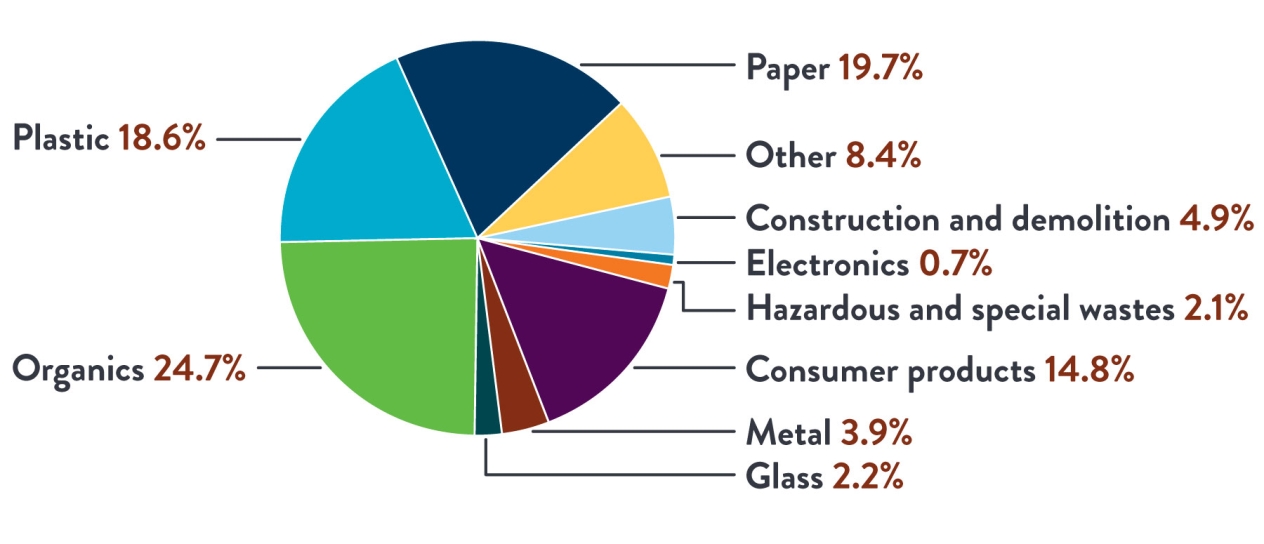
“You can’t manage what you don’t measure,” said Mark Rust, supervisor for sustainable materials management at the MPCA. “These results tell us that our work on prevention of wasted food, toxics reduction, organics recovery, packaging extended producer responsibility (EPR), and other priority work is targeting the most prevalent portions of the waste stream. This study also creates a baseline understanding of our waste that we can compare over time to ensure we’re focused on the right priorities.”

2025-2026 Waste Characterization Study
The MPCA commissioned a study in 2025 to determine what Minnesotans were putting in the trash. This data helps identify opportunities to divert materials through waste prevention, reuse, recycling, organics diversion, and waste processing.
The best piece of trash may be the one we never create
When people think about keeping things out of the trash, recycling is often the first solution that comes to mind. But the study can help Minnesotans look further upstream.
Management strategies generally offer greater environmental benefits when they prevent waste or allow products and materials to be reused before turning to recycling or composting. That means the question isn't only, “Could we have recycled this?” It can also be, “Did this need to become waste at all?”
Take food. Keeping food from becoming waste in the first place — or recovering edible food so it can be used — can keep it out of garbage cans altogether. Better meal planning and food storage can go a long way toward not just preventing wasted food but also saving money. For food scraps and other organic material that can't be saved, food donation for businesses like grocery stores or restaurants or organics collection for composting can provide another pathway that doesn’t involve the landfill.
Paper and plastic packaging are among the most prevalent materials identified in the study. There are also opportunities to reduce unnecessary packaging by bringing your own reusable bag to the grocery store or purchasing items that can be refilled to cut down on the overall amount of packaging. If there aren't ways to reduce packaging, look for drop-off recycling options for flexible film since it is not a material that can be put into your curbside recycling.
More opportunities for reduction, reuse, and recycling will become available with the implementation of the 2024 Packaging and Waste Cost Reduction Act that holds producers responsible for developing more sustainable packaging. The packaging EPR program maintains a statewide view of waste reduction, recycling, and composting, opportunities and needs.
What’s changed since the last waste sort?
This isn't Minnesota's first deep dive into its trash.
Researchers aligned the new data with statewide studies conducted in 2000 and 2013, allowing them to examine how the composition of Minnesota's waste stream has changed over time.
Paper now makes up a smaller share of disposed waste than it did in previous studies. Reflecting changes in media consumption over time, newsprint has seen a significant decline, accounting for 4.1% of disposed waste in 2000, 1.4% in 2013, and just 0.21% in 2026. Organics and plastics, meanwhile, show little change from 2013.
Those changes offer clues into changes in consumption patterns, product design, and waste management practices over the past 26 years. The study wasn't designed to determine exactly why the waste stream changed, so the results shouldn't be treated as proof of any single cause.
The results do provide an important new benchmark for measuring Minnesota’s trash so we can take steps to further reduce, reuse, and recycle.
Some small items can create big problems
Not every important finding is about which material weighs the most. Different materials create different environmental and management challenges and require different solutions.
Researchers also found lithium batteries and products containing batteries in disposed waste. When those items enter the waste or curbside recycling system, they can pose a fire risk, making proper collection and public education important even though batteries don't dominate the waste stream by weight. Minnesota law prohibits rechargeable batteries and products containing non-removable rechargeable batteries from being disposed of in mixed municipal solid waste.

Learn more about battery recycling
Visit the Battery Network to find a drop off location for batteries in your area or check with your local county household hazardous waste site for proper recycling options. Contact the location before dropping off batteries to confirm they accept the type of batteries you have.
The study also points to a newer complication: compostable products and packaging. These products may support organics management when they're properly identified and accepted by the appropriate system. But unclear labeling, certification or acceptance can also create contamination, sorting challenges and, ultimately, more waste.
State and local partners can use the updated data to evaluate existing programs, prioritize waste reduction and diversion efforts, direct funding and staff resources, and track whether Minnesota's waste stream changes over time.
This study won't be the last look inside the trash. Beginning in 2029, Minnesota solid waste facilities will face new waste-composition study requirements, and the methodology used here can help inform future data collection.
For Minnesotans, the study also offers a different way to think about their own garbage.
Every item inside their garbage cans came from somewhere. Resources and energy went into producing it, transporting it, and using it. And once we're finished with it, we make another decision on what happens next.
One bag of trash may not seem like much. Put millions of those decisions together, though, and they become Minnesota's waste stream legacy.