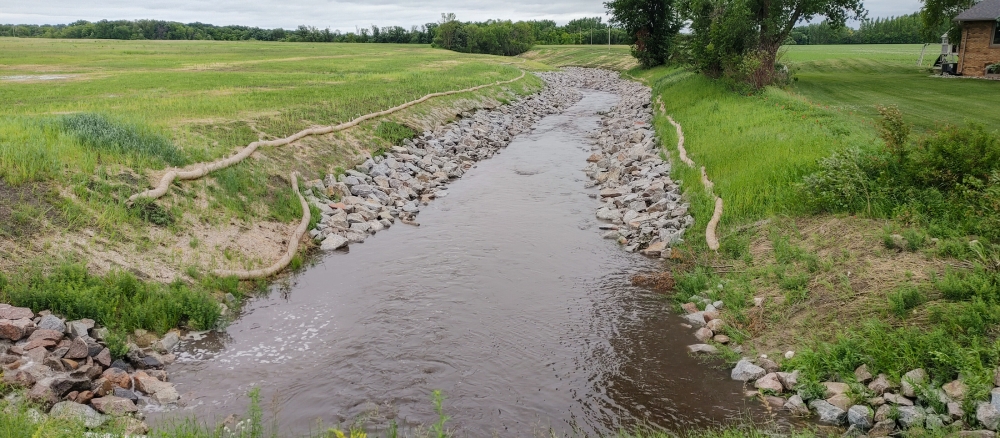
Cross-agency cooperation and diversified funding push work past the finish line
In the Red Lake River Watershed, communities are teaming up to protect waters that locals love to play in and anglers love to fish, whether it’s tubing on a hot summer day, paddling a kayak, or chasing trophy smallmouth bass.
Planning, funding, and partnerships lie at the heart of this work. Behind the scenes, a dedicated team from the Pennington, West Polk, and Red Lake soil and water conservation districts; Red Lake Watershed District; the Minnesota Board of Water and Soil Resources; and the MPCA have led the charge to restore the watershed through science-based interventions.
The Red Lake River and Black River, which ultimately flow westward toward The Red River of the North and the border between Minnesota and North Dakota, play a big role in the region’s water health. But more than a century of development in the region has created challenges.
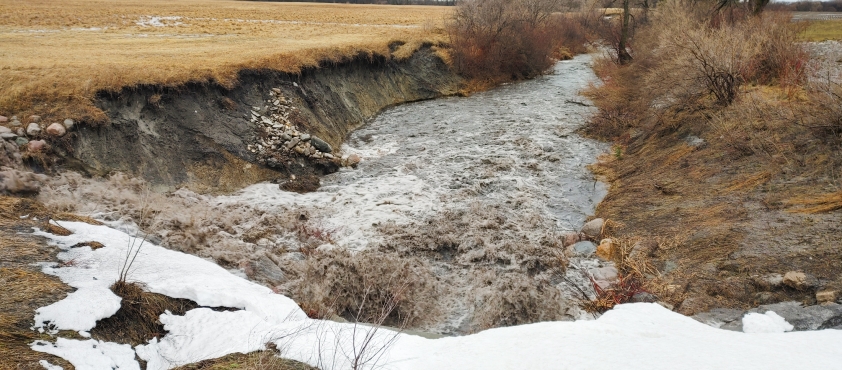
“A lot of drainage projects over the last 100-plus years have straightened streams, created ditches where streams never existed, and caused a lot of altered flow and flooding issues,” said Denise Oakes, a project manager for the MPCA, who began this work in 2013. “This can cause flooding, especially during snow melt when the river flows north and is still frozen downstream.”
Over the years, the MPCA has monitored water quality to identify where restoration work can most effectively improve river health. Lakes, rivers, and streams that fall short of clean-water standards go on the state’s list of “impaired waters.” The MPCA removes those that recover from that list, also known as “delisting.” In the Red Lake River Watershed, the focus is on those that are close to turning the corner, waters that need just a little extra care to reach or maintain good quality.
That’s where the Red Lake River and Black River nine-key element plan comes in. The MPCA and local governments developed the plan to meet U.S. Environmental Protection Agency (EPA) requirements for recipients of Section 319 Clean Water Act grants. Think of it as a roadmap for restoring slightly impaired but highly recoverable streams in a subwatershed of the Red Lake River Watershed. It’s connected to a larger initiative called One Watershed, One Plan (1W1P), which unites local partners to set priorities to protect and restore water resources across entire watersheds.
Recent projects include stretches of the Black River, County Ditch 99, and a portion of the Red Lake River between Thief River Falls and Crookston, which project partners chose for their high potential to recover. The goal: cleaner water, healthier fish, and thriving recreation for generations to come.
“Unfortunately, much of the Red River is impaired by high total suspended solids (TSS),” said Corey Hanson, water quality coordinator for the Red Lake Watershed District. “Many of its tributaries are impaired by high E. coli. Severe streambank erosion, unstable drainage outlets, runoff, and wind erosion from cultivated fields contribute to the TSS impairments.”
Water quality data helped identify stream segments near the impairment threshold. Work partners gave the highest priority to nearly impaired streams and those closest to being restored.
“The Red Lake Watershed District has been very active on environmental issues. They’re geared toward making sure that water quality is good, not just drainage,” Oakes said.
A key contributor to this progress has been the EPA’s Clean Water Act Section 319 Nonpoint Source Management Program. Established through amendments to the Clean Water Act in 1987, this grant program helps combat “nonpoint source pollution,” the runoff from landscapes that doesn’t trace to a single source but can severely impact water quality.
“We have been able to address large, daunting erosion problems in the Red Lake River Watershed by piecing together funding from multiple partners and grants,” Hanson said.
Work included three major erosion control and water quality improvement projects:
- Black River impoundment project (2020–2021). This initiative installed 52 side-water inlets to slow down runoff and built 39 rock barriers to reduce erosion where channels change elevation. These improvements cut sediment entering the Black River by 115 tons per year.
- Voyageur’s View streambank stabilization (2022–2023). Stabilizing 500 feet of streambank reduced 132 tons of sediment and 152 pounds of phosphorus entering the Red Lake River annually.
- Polk County Ditch 99 outlet stabilization (2023). This effort stabilized more than 1,000 feet of eroding channel, reducing sediment runoff by more than 700 tons per year.
These milestones highlight the importance of cross-agency cooperation and diversified funding. Fact sheets and outreach efforts on the RLWD website and social media have also helped share the news.
“Having reliable funding has allowed us to add water quality features to drainage and flood-damage reduction projects, opportunities that were often missed in the past,” Hanson said.
A combination of local, state, and federal contributions supported these projects, including Enbridge enforcement action payments, Red Lake River Watershed-Based Implementation Funding from the Clean Water Fund and administered by the Board of Water and Soil Resources, the Federal Emergency Management Agency, and support from landowners. The success of the Red Lake River watershed projects shows how the region is building momentum toward cleaner water and a healthier environment.