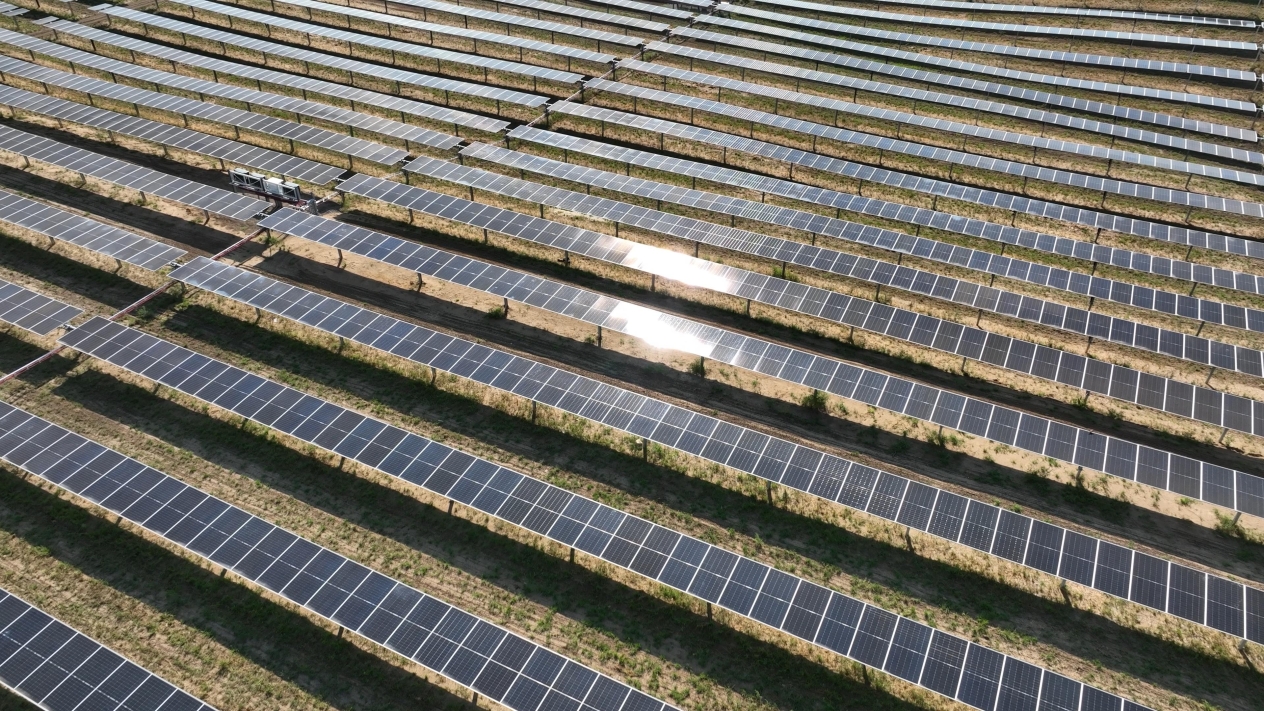
Solar panels soaking up the sun across a field next to the Anoka-Ramsey closed landfill are making use of land that faced specific challenges for development. In a growing community where land is precious and energy essential, the arrangement is a win-win for the city and environment. Additionally, this solar farm could become a model for transforming property in the Minnesota Pollution Control Agency’s (MPCA) Closed Landfill Program.
The work is part of a broader effort to find productive uses for former industrial and contaminated properties. These sites, known as “brownfields,” can be a challenge to redevelop and often sit idle for years. (In a clever turn of phrase, brownfields with solar panels installed on them are sometimes called “brightfields.”)
“There is widespread interest in developing solar on closed landfills,” said MPCA program manager Hans Neve. “They’re a unique kind of brownfield site. We’re never going to have a building, there’s not going to be a whole lot of intensive use, but these closed landfills do have potential reuses; think pollinator habitat, solar, athletic fields, things like that. These are good reuses for closed landfills.”
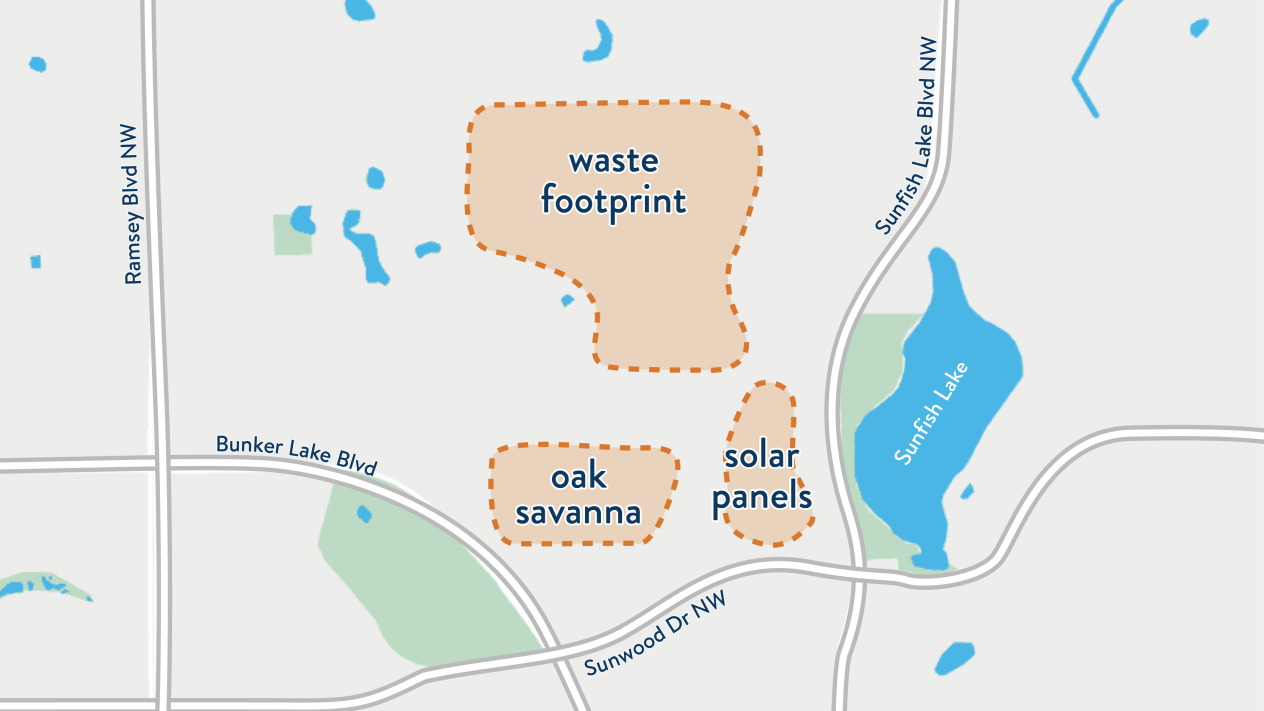
The Anoka-Ramsey closed landfill project sits in the southeast corner of Ramsey, a suburban city on the northwest edge of the Twin Cities metro region. Developers are building in the buffer area south of where garbage is buried, between a grove of oak trees and Sunfish Lake.
“The solar panels aren’t being built in the waste footprint, but on the state property surrounding the closed landfill,” said Stephen Mikkelson, an MPCA program supervisor. “It’s a perfect spot. It worked really well because there’s no worry about the solar project infrastructure breaching any liners or to dig into waste, anything like that.”
The MPCA monitors 112 closed landfills in perpetuity. But developing one into something with an economic use, like a solar facility, is different. There are many things to coordinate, and projects like this don't come along very often.
MPCA project manager Steven Theisen monitored the work to protect the state’s environmental interests and ensure the developer followed approved plans. He said this project is special. On an average day, his work involves managing closed landfill sites, making sure groundwater remediation systems and landfill gas collection systems are working. He checks up with the mowing, monitors tree growth so roots don’t damage the landfill cap, and other general land management.
“Overall, it's been a straightforward project, but there are many moving pieces. It isn’t simply a matter of finding land and installing solar panels. There are environmental reviews, surveys for threatened and endangered plant species, and areas that have to be avoided. This site also contains an oak savanna, which has ecological value and needed to be protected,” he said.
The road to solar
The 1994 Landfill Cleanup Act created Minnesota’s Closed Landfill Program. The program is an alternative to Superfund for cleaning up and maintaining closed landfills and was the first such program in the nation. The program manages these sites by monitoring environmental impacts, addressing contamination, and maintaining the systems that keep the area secure.
In 2019, the Minnesota Legislature asked the Environmental Quality Board to study the potential for solar development on Minnesota’s Closed Landfill Program sites. Solar development helps reduce greenhouse gas emissions and supports the state’s environmental mission, while creating jobs and revenue. Allowing solar development on closed landfills also can reduce development pressure on other lands, such as farmland and natural areas. The board delivered a report about the potential to the Legislature in December 2020.
One obstacle for the Anoka-Ramsey project wasn’t environmental but rather financial. To clean up the landfill, the state had issued bonds that needed to be paid off before a private company could install on the land. In 2021, the Legislature authorized removal of bond restrictions to allow beneficial reuse while ownership remains with the MPCA. Connexus Energy, headquartered in Ramsey, met the requirements to develop the land, and it negotiated a lease with the MPCA. The project was developed by Cedar Creek Energy, based in Blaine, in partnership with Connexus, owned by Kearsarge Energy. The Ramsey City Council approved the plan in April 2025. For fiscal year 2027, Connexus will pay $21,203 to lease the land. The state will use the rental income on future solar development. The lease term is 30 years.
Cedar Creek Energy expects the 4.125-megawatt, alternating current (AC) solar project to annually offset about 7,427 tons of carbon dioxide emissions, generate enough electricity to power the equivalent of 830 homes, and reduce reliance on fossil fuels.
“I’ve done a lot of things at PCA for the last 30 years,” Neve said. “Brownfields is one of the more satisfying bodies of work. When a brownfield redevelopment happens, it can really turn the whole neighborhood in a different direction.”