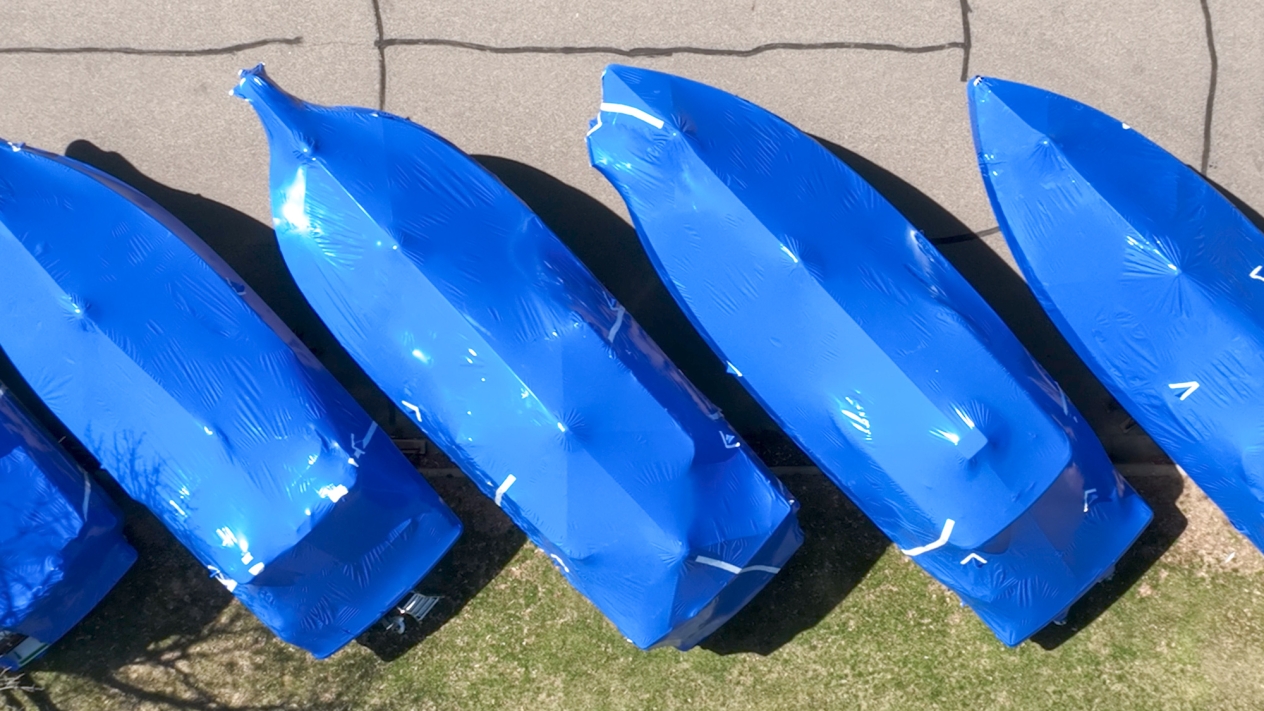
Throughout Minnesota’s long winters, plastic-wrapped boats stand dormant in marinas, storage yards, and alongside garages, waiting — like their owners — to be out on open water again. When spring finally arrives, the unwrapping begins.
The process yields tons of discarded wrap which, if collected properly, is kept out of landfills and can be recycled into everyday products such as flexible film, decking, furniture and more.
In 2024, Minnesota became the first state to pass a law establishing a product stewardship program for boat wrap, which requires producers to pay for collection, transportation, reuse, recycling, and disposal of the protective material through a stewardship organization. The program got fully underway this spring.
“It’s definitely exciting for Minnesota to be the first to try this,” Molly Flynn, MPCA boat wrap program coordinator, said. “We are uniquely positioned with how many boats and how many water resources we have for recreational use in Minnesota.”
A 'learning year'
The state’s designated stewardship organization, Commercial and Industrial Flexible Film Recycling Organization (CIFFRO), named its boat wrap program Wrap Recycle Right.
The program’s website offers an online map of statewide collection sites and temporary collection events. It also offers guidance for preparing boat wrap for recycling.
The Minnesota Pollution Control Agency (MPCA) is responsible for regulatory oversight of the program.
The goal for 2026 is to collect about 200,000 pounds of wrap, then in 2027 to double that amount. State law requires that no less than 50% of all boat wrap sold in Minnesota will be collected and recycled by June 1, 2030, and no less than 80% by June 1, 2035.
“We really wanted to set the goals this year to meet attainability and also use this year as a learning year for everybody involved from the program administrators, all the way to the collectors and the recyclers,” said Sarah Bonvallet, operations program coordinator for Wrap Recycle Right. “Then we'll use the next couple of years in between that to move ourselves towards the goals that the state has set out for the program."
Cutting out the landfill
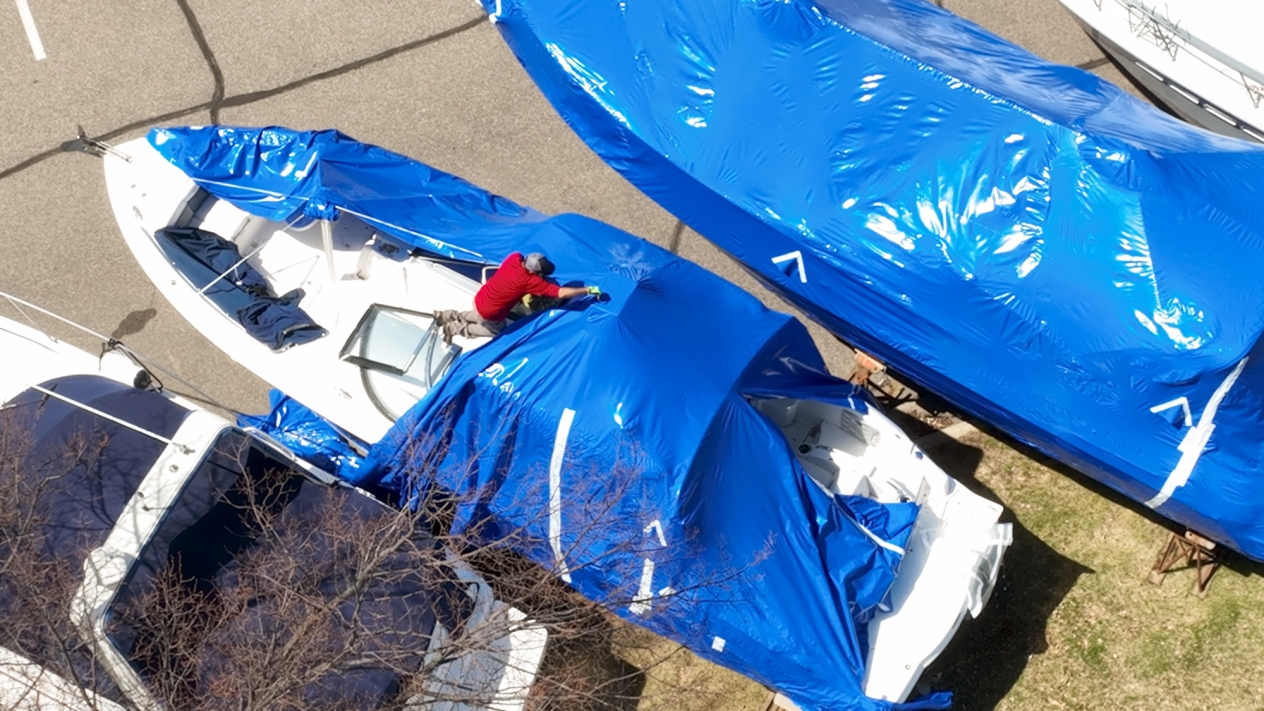
On a bright spring day at Bayport Marina, Jono Hoyos, co-owner of Stillwater-based The Boat Doctors, climbed onto the deck of a sleek 47-foot cabin cruiser to begin removing its winter coat of blue plastic wrap.
It took Hoyos, using a boxcutter and his gloved hands, about 15 minutes to fully unwrap the boat and another five minutes to gather the plastic into four neat rolls, like giant blue sleeping bags, before placing them under the bow, ready to be taken to a recycling container.
One down, hundreds more to go. During the two months roughly between Easter and Memorial Day, Hoyos said he and his team will unwrap 100-150 boats per week.
“Our phone’s been ringing off the hook,” he said.
But the unwrapping is not as easy as Hoyos, who has decades of experience, makes it look. To be accepted for recycling, boat wrap must be clean from dirt or debris, with non-recyclable materials like vents, zippers, strapping or wood supports removed, rolled into four-foot widths and tied into a bundle, per Wrap Recycle Right’s guidelines.
From there, Hoyos takes the material to a Wrap Recycle Right-approved, covered container for final transport to a recycling and processing facility.
Hoyos said he’s worked to get boat wrap to recycling sites for nearly 30 years and appreciates that the state established a law that requires producers — not individuals or small companies like his — to fund the process
“Customers, passersby, they are always wondering what happens with all this plastic when we’re done with it,” said Hoyos, who has advised Wrap Recycle Right to make the new program effective. “We tell them we recycle it. There’s a lot of plastic that we use and as stewards we like to make sure that it goes, to, not the dumpster. We don’t want to see thousands and thousands and thousands of pounds of plastic just taking up dumpster space and landfill space.”

Collection sites in Minnesota
Wrap Recycle Right has an online map of public collection sites and events, along with guidance for preparing boat wrap for recycling.
Getting a handle on the numbers
The MPCA and Wrap Recycle Right don’t yet have a way to measure the volume of boat wrap that’s used in Minnesota.
“It’s traditionally been ... straight to landfill primarily,” Flynn said. “And part of this program is trying to capture that metric and bring more awareness to what’s actually being generated and making the diversion possible
Getting a handle on those numbers, as well as continuing to work with boat owners, marinas, and municipalities to build awareness and a network of collection sites, will be important goals as the program ramps up toward its 2035 requirement of 80%.
“Sometimes we think we have unlimited landfill space because we don’t see these landfills,” Bonvallet said. “That’s why this law came into effect. That’s why it’s so important that this material gets to someplace where it’s properly recycled.”