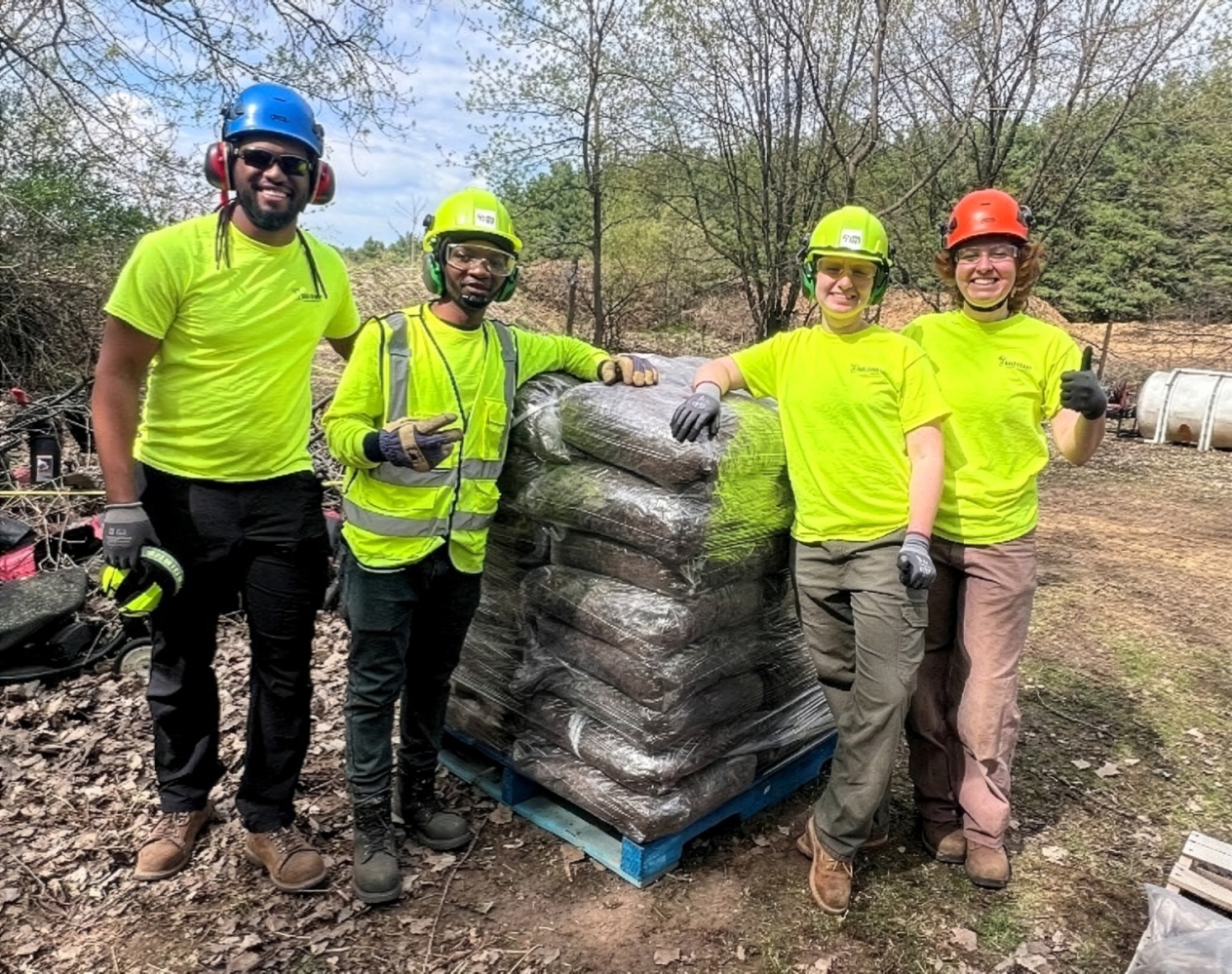
For 50 years, Tree Trust has been connecting people and trees in communities across the Twin Cities. The Saint Paul nonprofit provides job training for young people, partners with communities to plant and care for thousands of trees each year, and delivers professional landscaping and tree care services. Now, with support from a Minnesota Pollution Control Agency (MPCA) wood waste utilization grant, Tree Trust is turning another byproduct of its work into a new community resource.
“The wood utilization grant program was intended to go beyond just addressing managing large volumes of tree and wood waste,” said Tim Farnan, supervisor of the planning and assistance unit at the MPCA. “Tree Trust’s project shows that there are ways to get value from wood that would otherwise go to waste and that we can utilize that material to benefit the environment and the economy.”
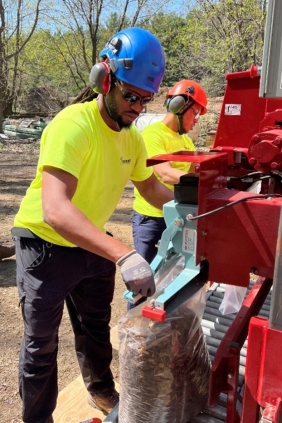
The $250,000 grant supports Tree Trust’s new Transforming Wood Waste initiative, which converts wood generated through tree care and landscaping into useful products while creating hands-on workforce training opportunities. Previously, Tree Trust contracted with an outside vendor to haul away or process wood from removed trees and brush. Grant funding allowed Tree Trust to purchase a mulch bagger, enabling staff and Career Pathways trainees to process wood waste on-site. Tree Trust then uses the bagged mulch at Community Forestry planting events and offers it for sale across the Twin Cities and Greater Minnesota. In 2026 alone, 19 trainees have gained experience operating the mulch bagger while producing more than 3,000 bags of mulch for newly planted trees.
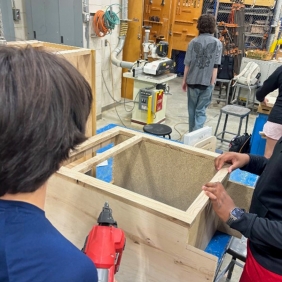
Future grant funding will add a wood pointer, sawmill, and kiln, allowing Tree Trust to manufacture products such as tree stakes and picnic tables for outdoor classrooms.
“The MPCA award for our Transforming Wood Waste initiative uniquely integrates the triangle — career pathways, community forestry, and landscape services — that makes Tree Trust what it is: an organization committed to transforming lives and landscapes,” said Bjorn Hawes, Tree Trust’s landscape services business operations manager.
Tree Trust’s project is one of eight funded through the MPCA’s Statewide Wood Waste Utilization grant, which was created to address a growing challenge across Minnesota. Wood waste, particularly urban wood waste, has been an increasing challenge since emerald ash borer was first discovered in Minnesota in 2009. While this has been acutely felt in the metro area, urban wood does not only refer to wood waste found in cities. Urban wood is lumber that is salvaged from trees that were removed for reasons other than a conventional timber harvest in cities, suburbs, and towns. Often these trees were removed due to urban expansion activities or following damage from storms, disease, or pest infestation. These trees contain valuable lumber but often require extra labor to transport, mill, and market. The Twin Cities metro area alone generates nearly 500,000 tons of wood waste each year.
Backed by a one-time appropriation from the Minnesota Legislature, the competitive grant program invests in projects that keep wood in productive use instead of sending it to lower-value disposal or processing. More than $9 million in proposals competed for roughly $1.38 million in awards. Funded projects are expanding sawmill and kiln capacity, producing biochar, studying future wood waste facilities, and developing workforce training programs that strengthen Minnesota’s wood waste infrastructure in underserved communities and environmental justice areas.
For Tree Trust, the investment builds on a half-century of community impact by creating new opportunities for both people and the trees they steward.
“Intentionally repurposing wood waste to benefit the community directly advances our mission,” Hawes stated. “Here’s to pursuing the next 50 years together!”
Grant recipients
City of Plymouth - $62,625
The city is developing a partnership with Minnetonka and St. Louis Park to direct salvageable timber from the chipping/ burning stream and to a better use with a shared kiln. The ability to dry wood locally reduces transportation costs and creates local products for businesses, residents, and the partnering communities.
East Phillips Neighborhood Institute - $249,979
The nonprofit organization is running four interrelated programs: maintaining the urban forest at Becketwood Cooperative; building a wood waste light processing facility and timber-framing education program; building urban farm infrastructure and a native tree nursery; and hügelkultur (a gardening technique that builds raised mounds from decaying wood and organic debris) and community compost systems.
Great River Greening - $184,561
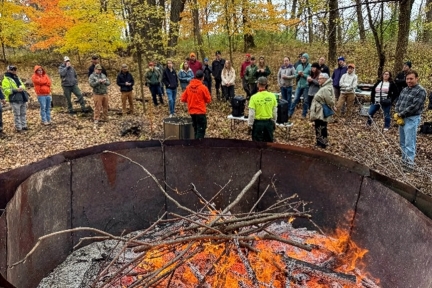
The nonprofit organization is addressing biochar kiln scalability as an effective on-site technique for processing wood waste material from natural resource management activities. On-site demonstrations of a variety of kiln types and results monitoring and dissemination are completed as part of habitat restoration and enhancement projects in partnership with other organizations, local government units, for-profit natural resource providers, and landowners.
Rainbow Treecare - $79,125
The company is addressing the issue of massive wood waste in the metro area through regenerative economies of scale. After assessing the supply chain and related issues, Rainbow and partners are presenting a business case for the development of a wood upcycling center with specific metrics for carbon capture, jobs, and product generation.
River Bend Nature Center - $60,590
The nonprofit organization is converting buckthorn and other non-native and invasive woody plants as well as dead ash trees from its approximately 400 acres of affected forested land into biochar. This reduces the amount of carbon emissions released and generates biochar for large scale tree plantings within the nature center, the city of Faribault’s community tree plantings, and for surrounding community members.
Storm Trees - $242,000
The lumber company is building a processing facility with a high-frequency, energy-efficient vacuum kiln that will become a resource for other sawmill operators who lack kiln access. Storm Trees is removing more wood waste material from the waste stream by opening their kiln drying services to small sawmill operators who otherwise would have directed material to the waste stream.
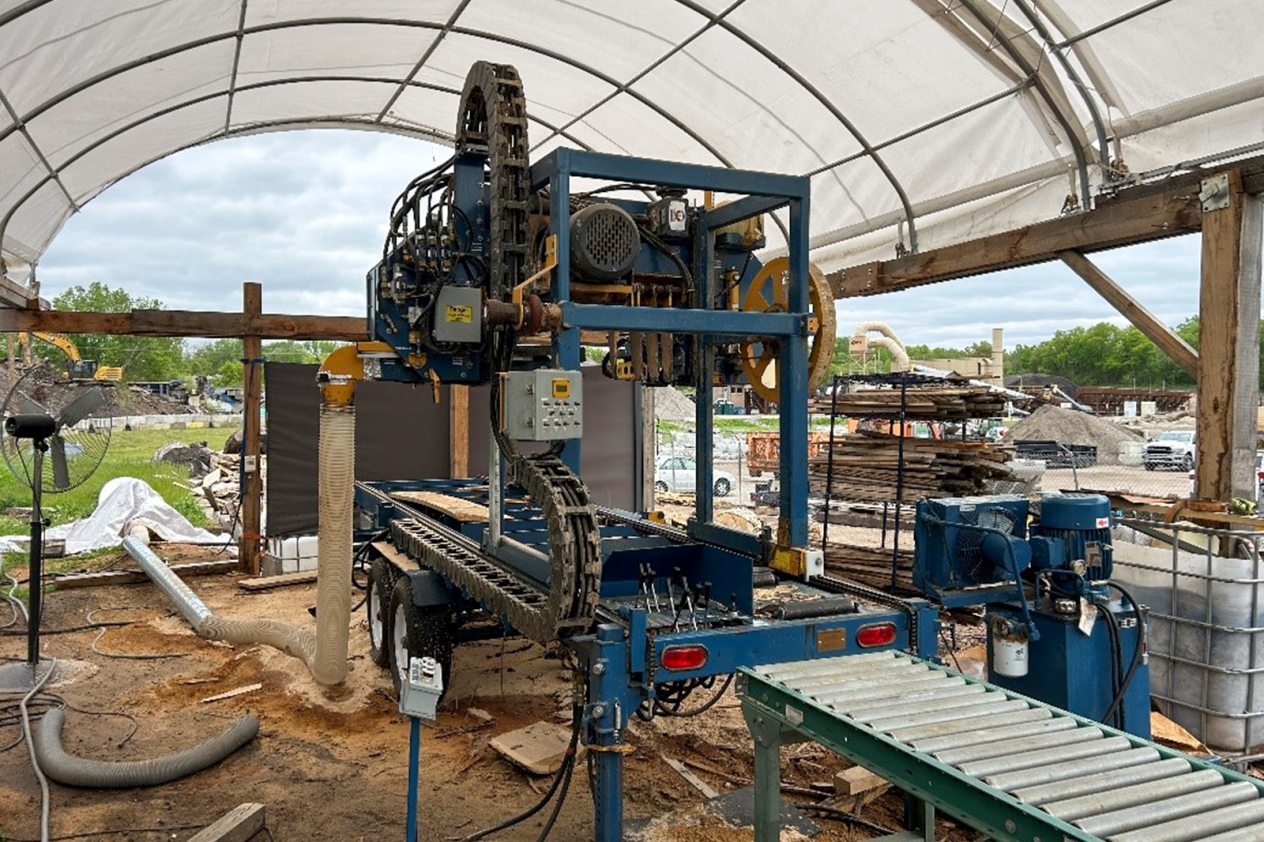
Tree Trust - $250,000
The nonprofit organization is purchasing foundational equipment to launch a long-term project to transform wood waste into valuable wood products. Woody tree debris will be repurposed into mulch and durable wood products while providing hands-on wood waste processing training and environmental stewardship education for young adults from underserved communities who are pursuing green industry careers.
Washington County - $250,000
The county is developing a model system of woody debris management where all county resident-generated tree debris can be diverted to the highest and best possible use based on the recoverability of the material. An air curtain incinerator will produce biochar from unmarketable urban wood.