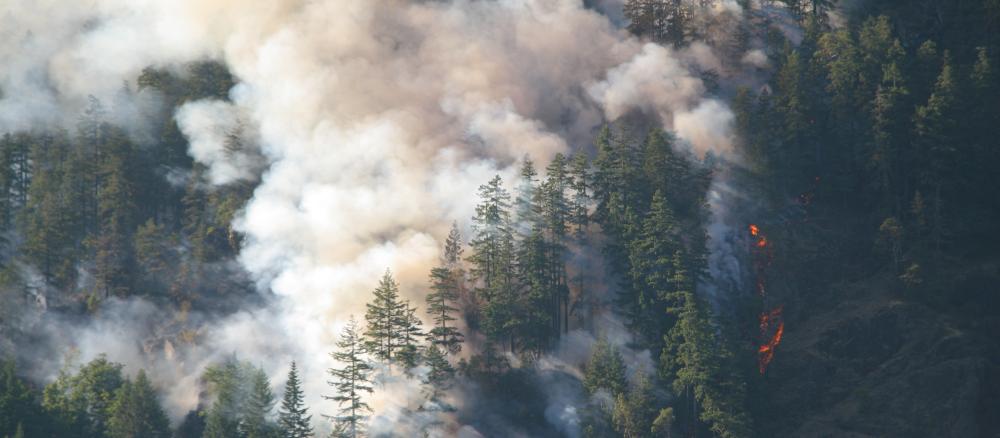
Last July and August, you may remember a stretch of hazy days, red sunsets, and warnings about poor air quality. Summer it seems, has a new regular companion: wildfire smoke.
If it seems like the number of air alert days due to wildfires has increased in the past few years, you’d be right. According to MPCA’s air quality meteorologists we’ve had 46 air quality alerts since 2015, and 34 of those were due to wildfire smoke.
The recent trend in wildfire smoke events really took off in 2021. Out of all the alerts since 2015, 26 were issued last year, with 23 due to wildfire smoke in July and August. "Last summer was truly historic and unprecedented in terms of the number of alerts and severity of measured smoke levels," says MPCA meteorologist Matt Taraldsen. "Not only were many parts of the state under smoke for a very long duration, but we had areas where smoke levels reached the Purple AQI category. These were levels never before recorded by our monitors."
It might be surprising to learn that origin of all this smoke is most often from fires thousands of miles to the north in Canada. “These are long-range transport events,” says MPCA meteorologist David Brown. “We’ve seen many large and intense fires across western Canada that generate an enormous amount of smoke. Weather patterns can carry the smoke long distances and bring it south across the border. This produces adverse air quality impacts for Minnesota.”
While the massive fires in California, Oregon, and Washington are the ones we hear about most often, Brown said the fires that dimmed the sun in Minnesota last year were just a few hundred miles north in northwest Ontario. “The smoke from the Pacific Northwest has to get over the Rockies Mountains and mostly stays aloft once it reaches us. The fires in Ontario were also huge, and when we had cold fronts move through region, it pulled the smoke right into the state,” Brown said. "The main reason why we experienced such severe smoke last year was because this smoke would stay trapped near the ground and didn't have very far to go before reaching us."
Wildfire smoke and health
According to Nick Witcraft, another MPCA meteorologist, smoke from wildfires contains a variety of pollutants that are problematic for human health. “Smoke contains carbon dioxide, water vapor, carbon monoxide, particles, hydrocarbons, other organic chemicals, and nitrogen oxides. But the pollutant that’s the most concern is fine particles. Those are the ones that seem to do the most damage to the lungs and the heart.”
Fine particles, also called PM2.5, are small, with diameters of 2.5 micrometers and below. For comparison, a human hair is 50 to 70 micrometers in diameter.
PM2.5 has significant health effects, not just on the respiratory system but the cardiovascular system as well. When levels are forecasted to be in the Orange category on the Air Quality Index, the MPCA issues an air quality alert. “Sensitive populations are most likely to be adversely impacted by poor air quality. People with lung and heart conditions, like asthma and COPD, children, and the elderly may be affected with the AQI reaches the Orange category,” Witcraft said. “However, everyone can be affected when air quality gets even worse during smoke events. When the AQI reaches the Red category or even higher like we saw last year, even a healthy person may experience symptoms, especially if they’re outdoors breathing hard and exerting themselves”
A new normal
With “megafires” now the new normal in the west, MPCA meteorologists expect we’ll see more of the same for years to come. Climate change has contributed to record hot summers and a severe and persistent drought across the western U.S. and Canada. The recent hot and dry summers have enhanced the drying of organic matter in forested areas. These conditions also contribute to the spread of insects like the mountain pine beetle, which weaken and kill trees. These factors have greatly increased the amount of fuel available for wildfires, and have created an environment where fires can grow rapidly and become very difficult to extinguish.
"Fortunately, the cool and wet spring across northern Minnesota and southern Canada has improved drought conditions where large fires occurred last summer. We're hopeful that we won't see large fires close to home again this summer, however another hot and dry summer is expected again out west," Witcraft said.
Protect your health by being air aware
The MPCA will continue to monitor these distant smoke plumes and forecast their effect on air quality during this summer's wildfire season. MPCA’s meteorologists have a suite of data and tools to create daily air quality forecasts and issue air quality alerts when poor air quality is expected. To stay informed about your local air quality forecast visit the Air Quality Index page, where you can also download the AirNow mobile app for Android or Apple.
Many mobile device weather apps also have air quality information included. You can also follow @MPCA_AQI on Twitter for daily forecasts and detailed air quality information.
May 2 marks the beginning of 2022 Air Quality Awareness Week a national campaign coordinated by the U.S. Environmental Protection Agency. For additional air quality resources and events follow #AQAW22 on social media now through May 6, 2022.