
Lori Becker has spent her life teaching outdoors, believing the best classroom has no walls. In Little Falls, she loves unloading a bus full of kids near a riverbank and watching wonder take over. “Water brings out their curiosity,” she said. Her lessons range from dipnetting insects to tracing the water cycle and exploring how water connects plants, animals, and people.
Those hands-on moments often spark deeper understanding. Kids who only know water from a tap suddenly see entire ecosystems living beneath the surface. Lori looks forward to “that aha moment when they realize they are part of the environment.”
Her own connection to water is just as strong. She lives across the street from the Mississippi, and after chaotic days, she walks to the river to settle herself with its smell, sound, and movement. Water is both elemental and spiritual for her.
“Water and God both provide life, give life, and are life,” she said. It’s why she teaches kids that protecting water is essential, because without clean water, clean air, and safe food, “we have nothing left.”
Visit We Are Water MN in Little Falls
Lori Becker shared her story as part of We Are Water MN, a traveling exhibit and community engagement program that explores Minnesotans’ relationships with water. Great River Arts in Little Falls will host the exhibit from Aug. 14 to Oct. 3.
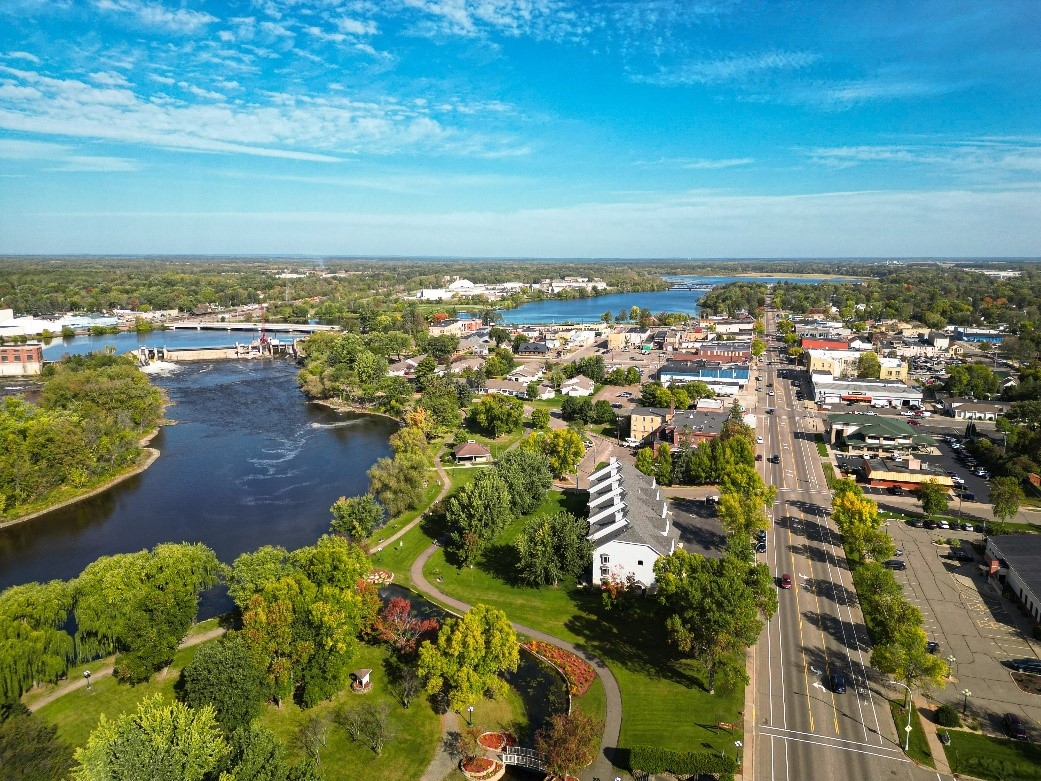
Little Falls sits on the banks of North America’s greatest river. Known in Ojibwe as Misi-ziibi (“Great River”), the Mississippi River flows about 2,350 miles from its headwaters in Lake Itasca, draining all or part of 31 U.S. states and two Canadian provinces, before emptying into the Gulf of Mexico.
As it travels south, the Mississippi grows larger and more powerful, fed by major tributaries including the Minnesota, St. Croix, Wisconsin, Des Moines, Illinois, Missouri, Ohio, and Arkansas rivers.
In Little Falls, both the river and the surrounding landscape begin to change dramatically. Within the city, the Mississippi flows over a series of small waterfalls that the Ojibwe called kakabikans, meaning “little falls.” Just south of town, the river continues its descent, dropping approximately 6.5 feet per mile between Little Falls and Royalton.
The landscape changes here as well. From its headwaters through Aitkin and Brainerd, the Mississippi flows primarily through forests and grasslands. South of Little Falls, the river enters a landscape increasingly shaped by agriculture and residential development. As development increases, so do impacts on water quality.
Protecting the river's water quality depends on good land stewardship. Keeping livestock out of streams, maintaining vegetation along waterways, reducing soil erosion, managing manure responsibly, and picking up leaves, grass clippings, pet waste, and other pollutants from streets and sidewalks all help keep the Mississippi River healthy for people and wildlife.
Visit the We Are Water MN exhibit at Great River Arts located at 122 1st Street SE in Little Falls to hear local stories and learn more about water in and around the area. The exhibit will be open 10 a.m. to 5 p.m. Wednesday through Friday and 10 a.m. to 2 p.m. on Saturdays.
About We Are Water Minnesota
We Are Water MN is a project of the Minnesota Pollution Control Agency and the Minnesota Humanities Center in partnership with the Minnesota Historical Society; the Board of Water and Soil Resources; the Minnesota Departments of Agriculture, Health, and Natural Resources; and the University of Minnesota Extension.
We Are Water MN is paid for by the Clean Water Fund, part of the Clean Water, Land, and Legacy Amendment that was created with the vote of the people of Minnesota on Nov. 4, 2008.