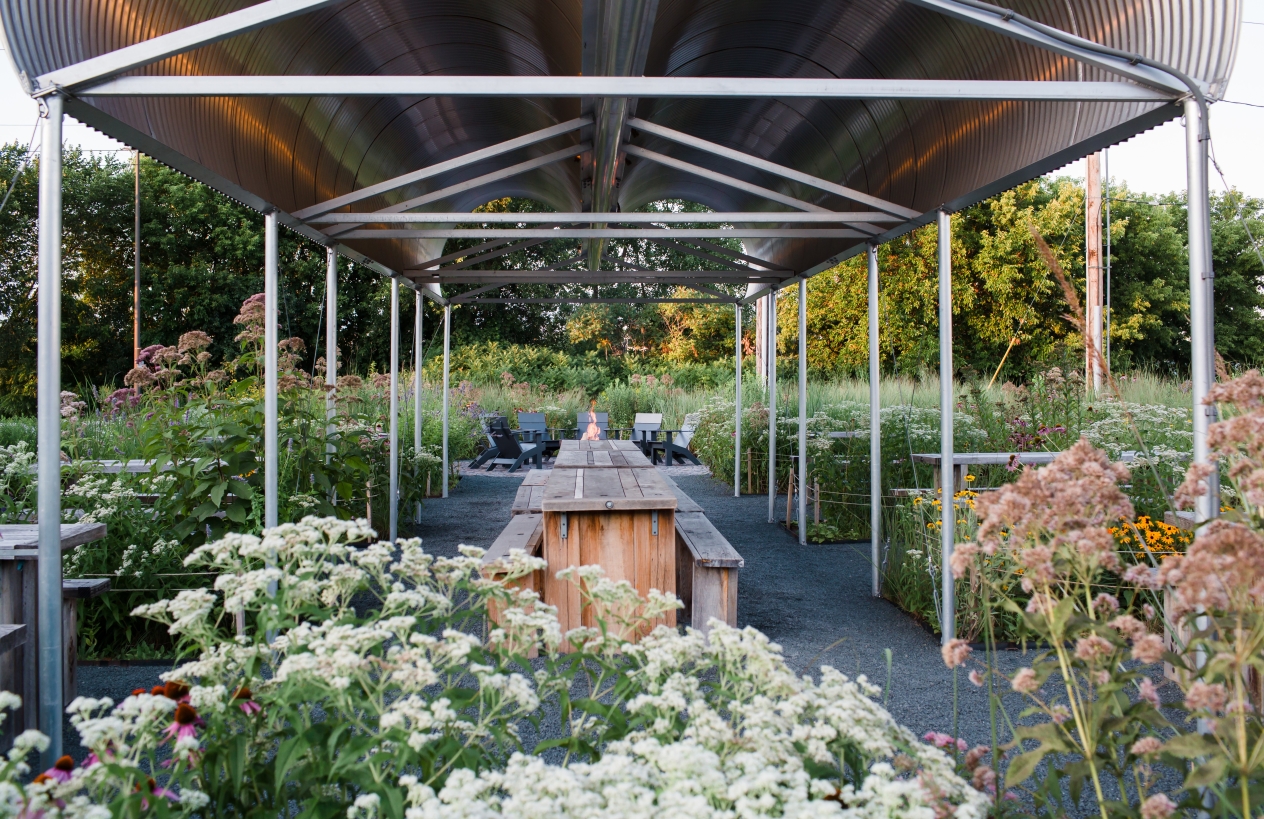
What began as a small brewing project has grown into something much larger for Sandy and Jay Boss Febbo. Their brewery is a space where water, land, and community all come together. After years of home brewing, they built their brewery inside a 1,300-square-foot grain bin in Saint Paul, surrounded at the time by pavement. Early attempts to plant barley on the site quickly revealed a problem.
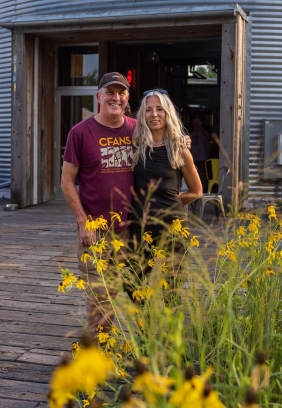
“We learned after doing that planting that we get all the stormwater runoff,” Sandy said. “It rolled our germinated barley into the street… and we had our eyes open to rain gardens.” What they first saw as a setback became a clear call to rethink how water moved through their space.
With help from local conservation partners, they transformed their property into a system designed to slow, capture, and filter water. Rain gardens now curve around the site, native plants fill the landscape, and even the ground beneath visitors’ feet is designed to absorb rainfall. Seeing it all come together was powerful. “It was so incredible to watch it function during a rain event,” Sandy reflected. “We were so inspired.”
Their approach has always been thoughtful and gradual — what they call “no sudden moves” — making decisions over time to create the greatest impact with the smallest footprint.
Water remains at the center of everything they do, shaping not only how they brew, but how they care for the land around them. Their gardens are now fully established, drawing in pollinators and creating a space where people can gather, learn, and slow down. What was once an expanse of asphalt has become something alive and regenerative.
“We have one water,” Sandy said. “And how we treat what is at our fingertips matters.”
Learn more in the We Are Water MN exhibit
Sandy and Jay Boss Febbo shared their story as part of We Are Water MN, a traveling exhibit and community engagement program that explores Minnesotans’ relationships with water. Capitol Region Watershed District began hosting the exhibit in Saint Paul on Earth Day.
The Capitol Region Watershed District (CRWD) covers a densely populated, urban area with five much-loved lakes: Como Lake, Loeb Lake, Big and Little Crosby Lakes in Saint Paul, and Lake McCarrons in Roseville. All water in the district eventually flows to the Mississippi River.
The CRWD is dedicated to protecting, managing and improving lakes, rivers, streams, and wetlands in the district, which includes parts of Falcon Heights, Lauderdale, Maplewood, Roseville, and Saint Paul.
The district was formed after a small group of residents gathered to discuss their concerns about Como Lake in 1995. Three years later, the Minnesota Board of Water and Soil Resources approved their petition to create the Capitol Region Watershed District. In the past two and a half decades, it has grown into a national leader in stormwater management.
Visit the exhibit to hear local stories and learn more about water in the Saint Paul area at CRWD’s Watershed Learning Center, located at 595 Aldine Street, Saint Paul, MN 55104. The exhibit runs from April 23 to June 14, 2026, and is open 10 a.m. to 4 p.m. on Mondays, Wednesdays, Thursdays, and Fridays, and 1 to 7 p.m. on Tuesdays. Admission is free.
About We Are Water Minnesota
We Are Water MN is a project of the Minnesota Pollution Control Agency and the Minnesota Humanities Center in partnership with the Minnesota Historical Society; the Board of Water and Soil Resources; the Minnesota Departments of Agriculture, Health, and Natural Resources; and University of Minnesota Extension.
We Are Water MN is paid for by the Clean Water, Land, & Legacy Fund that was created with the vote of the people of Minnesota on Nov. 4, 2008.