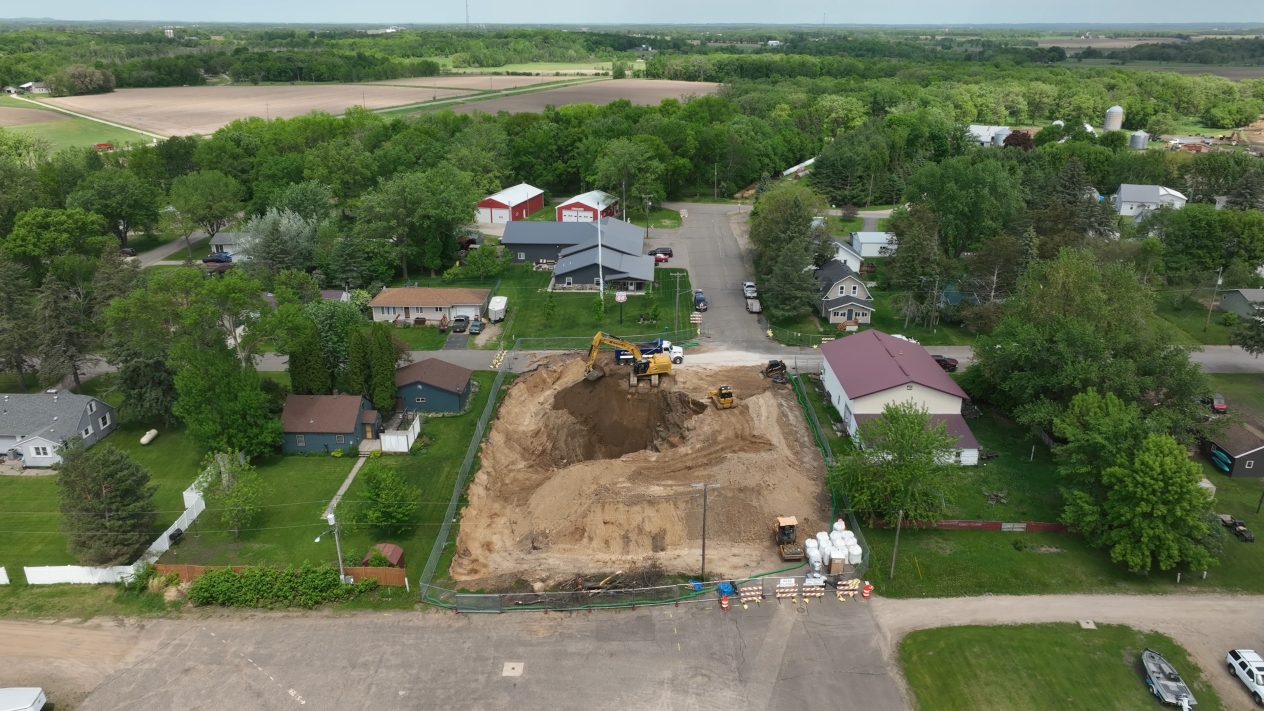
One of the biggest things to happen this summer in the tiny town of Flensburg was a 20-foot-deep hole in the middle of town and the decades-old pollution it removed. In a case where the parties responsible for the contamination were no longer living, the Minnesota Pollution Control Agency (MPCA) stepped in to clean the site, a process called remediation.
The project included the rare step of the agency purchasing the land, about 116 miles northwest of St. Paul. The previous owners had operated a gas station there for 17 years. After closing the business, they pulled the tanks out of the ground in 1989 and discovered petroleum contamination in the soil. The MPCA investigated the extent of contamination and damage to drinking water. After the last remaining owner passed away, the family and MPCA made an agreement about purchasing the property so the cleanup could move forward.
“It’s been a very old, longstanding site in the petroleum program,” said Stephen Frye, a project manager for the MPCA. “We’re finally on the path to corrective action after all these years.”
In May 2026, the MPCA blocked off two streets in the middle of the Morrison County town and removed 6,800 cubic yards of soil. That’s about 500 dump truck loads, which amounts to more than two loads for each of the city’s 212 residents. Upon completion of the excavation, the site property will be restored to a grass lot. The intersection will be covered with new asphalt. Eventually, the land will be sold.
“Once the work is completed here, it will be restored back to a flat, grassy lot. And we will put the two streets and repave those back in,” Frye said. “We’re always committed to making sure that when we investigate and clean up the site that we are leaving it better than it was found.”
The Flensburg City Council has advocated for the past couple years to get bonding dollars through the State Legislature to build a reliable source of drinking water. But for now, the community relies on private wells. Removing the contaminated soil is a huge step toward protecting human health.
“The residents are ready to move on from this. They are eager to have the site cleaned up,” said Carol Merten, Flensburg city clerk and treasurer.
Merten said she appreciates how the MPCA and hired contractors kept the town informed about the work and expected results. The support was especially appreciated because of the town’s size.
“Our city is rather small,” Merten said. “We have an empty lot right in the middle of our little city. After the cleanup, it will mean that someone could build on that site and help the tax base of our city and allow us to continue our family-oriented community.”
Merten lives next door to the cleanup site, which used to be a gathering spot for residents. The former post office and fueling station was a place where residents could get mail, buy gas, and visit with neighbors. She described Flensburg as a community worth investing in.
“It is a great little place to live. I mean, it’s close-knit people. Neighbors watch over neighbors. It’s a great little family place,” Merten said.
The MPCA manages many petroleum cleanup cases statewide, averaging about 700 open cases at any given time. Properties can face the risk of petroleum vapors intruding into homes and nearby buildings, and contaminated groundwater can impact private wells. That’s why the MPCA decided to remove such a large amount of dirt in Flensburg. Once the source of the contamination has been removed, the remaining petroleum will naturally degrade over time.
“We’re removing a significant portion, but we’re not going to get it all,” Frye said. “We’re putting gypsum on the bottom of the excavation to help degrade whatever’s left behind.”
The contaminated soil will be disposed of at a landfill designed to safely handle the waste. Follow-up testing at the site will involve taking samples from monitoring wells to verify that residual petroleum contamination is degrading and no longer poses a health risk. The MPCA anticipates long-term groundwater monitoring and sampling of private wells will continue until the MPCA determines that site closure is possible.
“It’s been great that the MPCA has been able to come in and take care of that for us,” Merten said. “It really has been a blessing.”