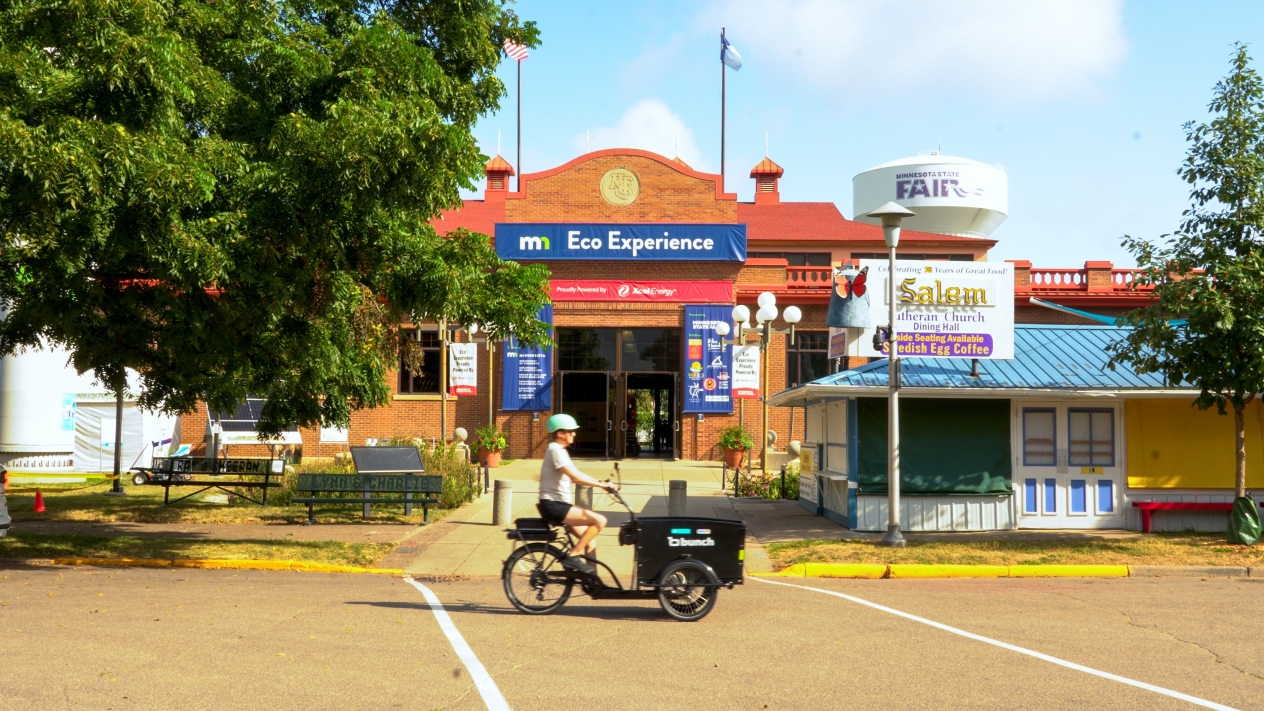
The reasons people choose an e-bike can be as practical as they are personal: a shorter commute, a car-free errand run, a way to carry groceries, or simply the ability to go a little farther without arriving sweaty and tired. For Angela Olson, an e-bike has meant all of the above. As the deputy director of Bicycle Alliance Minnesota (Bike MN), she spends her days supporting efforts to make Minnesota safer for people walking, biking, rolling, and using transit. Outside of work, she’s a daily e-bike rider herself.
"When I first got an e-bike, I got it because it was kind of cool and it really meant I could get places without getting as sweaty,” Angela said. “On a non-e-bike, the radius I can ride has shrunk as I've gotten older. I love the freedom, reliability, and extra boost of power that I get from now riding an e-bike.”
People of all ages are choosing e-bikes for commuting, running errands, and recreation. For some riders, an e-bike is a way to replace a short trip by car. For others, e-bikes make it possible to ride year-round, carry more, or travel farther.
That matters for the environment, too. When an e-bike replaces a car trip to the grocery store, a commute to work, a school drop-off or another short errand, it can mean less fuel burned and less pollution produced.
See the possibilities at Eco Experience
At this year's Minnesota State Fair, visitors to Eco Experience can see and test out that variety for themselves.
The exhibit will feature many different styles of e-bikes, from individual commuter bikes to cargo bikes and other specialized designs. E-bike experts, including bicycle shop staff and e-bike owners, will be on hand to answer questions and talk with visitors about how they use their bikes.
Some of the bikes on display demonstrate how an e-bike can fit into everyday transportation in unexpected ways.
The Swytch GO, for example, is a conversion system that can turn an existing push bike into an e-bike. Instead of replacing a bicycle, riders can add electric assistance to a bike they already own. For someone considering an e-bike for commuting or errands, that can offer a way to make an existing bicycle more useful for longer or more challenging trips.
Other e-bikes are designed from the beginning to solve specific transportation needs. The Van Raam Chat is a side-by-side tandem e-bike that allows two people to ride together. Its three-wheel design and electric assistance can make cycling possible for people who may not be comfortable or able to ride a conventional bicycle on their own.
A cargo e-bike from the MN Cargo Bike Library will also be on display. The community-run program allows Minneapolis and Rochester residents to rent a cargo bike from its small fleet for a week before deciding whether to invest in one of their own. The program, operated through Bike MN, is made possible through partnerships with Cyclehoop and the Lyndale Neighborhood Association, along with grants from the Minneapolis Foundation and CERTs.
The library’s goal is to give Minnesotans the knowledge, skills, and resources they need to safely and confidently replace car trips.
“Not all e-bikes are made the same and, like many purchases, you get what you pay for,” said Laura Mitchell, founder of the MN Cargo Bike Library. “If you’re shopping for an e-bike, be sure to do your research: buy from a reputable company, figure out which local bike shops will service it, and invest in a bike with good quality components so it’ll last many years.”
E-bike or e-moto? Know the difference
As electric-powered two-wheelers become more common, it can be difficult to tell an e-bike from other electric vehicles. Some motorized vehicles are marketed as “e-bikes” but do not meet Minnesota's legal definition of an electric-assisted bicycle. These vehicles may travel at much higher speeds and are subject to different laws.
In Minnesota, e-bikes are divided into three classes, with specific requirements for how the motor operates and how fast it can assist the rider. A Class 1, 2, or 3 e-bike has fully operable pedals and an electric motor with a power output of 750 watts or less.
Some key differences include:
- Operable pedals: E-bikes are required to have fully operable pedals; the electric motors may only assist the rider’s pedaling. E-motos are not required to have operable pedals; pedals, when present, may be decorative.
- Motor power: E-bikes have motors rated at 750 watts or less. E-motos can have motors ranging from 1,000 to 6,000 watts or more.
- Top speed: Depending on the class, e-bikes provide electric assistance up to 20 or 28 miles per hour. E-motos may reach 30 to 65 miles per hour or more.
- Throttle: Class 2 e-bikes may use a throttle, but the motor must stop providing assistance at 20 miles per hour. E-motos are commonly designed to be throttle-only.
- Licensing and registration: E-bikes do not require licensing or registration. E-motos may require licensing and registration because they are motor vehicles.
- Street legality for minors: E-bikes can be ridden by minors who meet Minnesota's requirements. E-motos are not street legal for minors unless properly registered and licensed and the rider meets applicable requirements.
The distinction matters because a vehicle's appearance or the name used to market it does not determine whether it is legally an e-bike. Before purchasing, verify the vehicle's specifications and make sure you understand what you are buying.
Buy local and ride safely
Choosing the right e-bike is only part of the equation. A Minnesota bicycle retailer can help riders understand state and local regulations and find a bike that fits how they plan to use it.
Battery safety is also important. When purchasing and using an e-bike:
- Buy an e-bike that is Underwriters Laboratory (UL) certified.
- Do not purchase aftermarket batteries.
- Only use the manufacturer's cord and power adapter made specifically for the bike.
- Dispose of used batteries and chargers at a designated battery recycling center. Do not throw them in the trash.
- Follow all manufacturer's instructions for battery charging and storage.
When riding an e-bike, wear a helmet and always be sure to follow the rules of the road!
Learn more at Eco Experience
Learn more about e-bikes and help us celebrate the 20th anniversary of Eco Experience at the Minnesota State Fairgrounds, beginning Aug. 27. This 12-day exhibition will feature hands-on activities, demonstrations, and resources to help Minnesotans lead a more sustainable life.