News release

June 8, 2026

Contact

MPCA communications, news.mpca@state.mn.us

Air quality alert issued due to ozone for Tuesday, June 9, for the Twin Cities and central Minnesota

Image
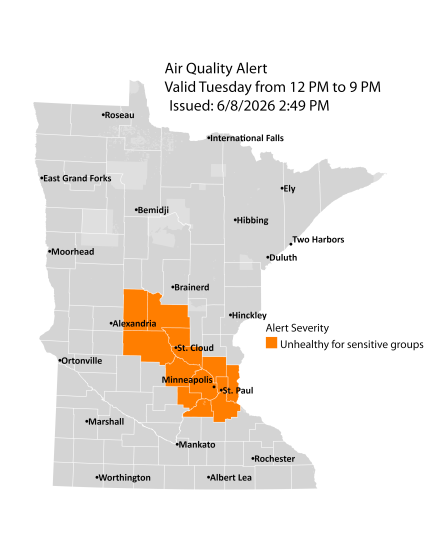
map showing air quality alert issued on June 6 for the Twin Cities and central Minnesota

Air quality is expected to reach the orange AQI category, which is unhealthy for sensitive groups, in the Twin Cities and central Minnesota

The Minnesota Pollution Control Agency (MPCA) has issued an air quality alert for the Twin Cities and central Minnesota. The alert takes effect at noon on Tuesday, June 9, and runs until 9 p.m. on Tuesday, June 9. The affected area includes the Twin Cities metro area, St. Cloud, and the Tribal Nations of Prairie Island and Mille Lacs.

Ground-level ozone is expected to be high on Tuesday afternoon in the Twin Cities metro area and central Minnesota. Mostly sunny skies, warm temperatures, and low humidity will provide a favorable environment for two types of pollutants (volatile organic compounds and nitrogen oxides) to react with sunlight in the air to produce ground-level ozone. Ozone is expected to increase during the late morning, reach alert levels during the afternoon, and then subside in the early evening. 

Air alert ozone

What this alert means

The air quality index (AQI) is color-coded. Air quality alerts are issued when the AQI is forecast to reach an unhealthy level, which includes forecasts in the orange, red, purple, and maroon categories. For a full description of each air quality category, visit airnow.gov.

Health effects 

There are people who are more likely to be affected when ozone pollution reaches an unhealthy level.

  • People who have asthma or other breathing conditions like chronic obstructive pulmonary disease (COPD), chronic bronchitis, and emphysema.
  • Children and teenagers.
  • People of all ages who are doing extended or heavy, physical activity like playing sports or working outdoors.
  • Some healthy people who are more sensitive to ozone even though they have none of the risk factors. There may be a genetic base for this increased sensitivity.

Unhealthy ozone can aggravate lung diseases like asthma, emphysema, and COPD. When the air quality is unhealthy, people with these conditions may experience symptoms like difficulty breathing deeply, shortness of breath, throat soreness, wheezing, coughing, or unusual fatigue. If you are experiencing any of these symptoms, use your inhalers as directed and contact your health care provider.

Take precautions: Everyone should take precautions when the air quality is unhealthy.

  • Take it easy and listen to your body.
  • Limit, change, or postpone your physical activity.
  • Move outdoor activities to the morning or late evening when ozone levels are lower.
  • If possible, stay away from local sources of air pollution like busy roads and wood fires.
  • If you have asthma, or other breathing conditions like COPD, make sure you have your relief/rescue inhaler with you.
  • People with asthma should review and follow guidance in their written asthma action plan. Make an appointment to see your health provider if you don’t have an asthma action plan.
  • Ground-level ozone is a gas. Masks will not provide protection like they do with wildfire smoke, which is fine particle pollution.

Pollution reduction tips 

Ozone is produced on hot, sunny days by a chemical reaction between volatile organic compounds and oxides of nitrogen.

  • Reduce vehicle trips and fill the gas tank at dawn or dusk.
  • Encourage use of public transport, or carpool, when possible.
  • Postpone use of gasoline-powered lawn and garden equipment on air alert days. Use battery or manual equipment instead.
  • Avoid backyard fires.

Stay informed