Minnesota climate smart food systems (CSFS)
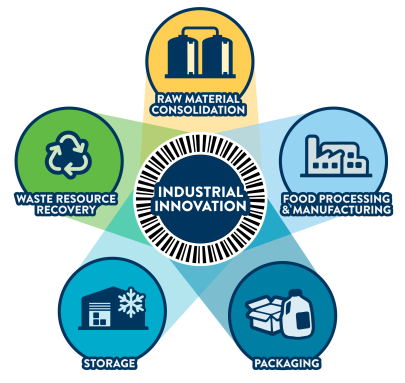
The Minnesota Pollution Control Agency’s (MPCA) industrial innovation in food systems program provides competitive grant funding to food and beverage manufacturing facilities and food system organic waste processing sites to cut climate pollution, improve efficiency, and reduce waste. Funding will help ensure that Minnesota’s food and beverage industry remains competitive, operational, and located within Minnesota.
The MPCA is soliciting proposals to distribute $40 million in grant funding to support industrial food and beverage manufacturers and food system organic waste processors across Minnesota.
Funding is intended to execute capital expenditure (capex) projects at facilities that will improve operational efficiency, reduce operating costs, and lessen environmental impacts by reducing greenhouse emissions, criteria air pollutants, hazardous air pollutants, and/or waste.
For this round, applications are due no later than 4 p.m. Central Time on Jan. 4, 2027.
The MPCA will accept and evaluate applications on a 3-month schedule, until April 1, 2028, or until funds are fully expended, whichever occurs first.
Questions and answers
Applicants who have any questions regarding this RFP must email questions to grants.pca@state.mn.us, subject line: “Questions for Industrial Innovation Implementation Grants.” Answers to questions will be posted frequently in the SWIFT Supplier Portal.
MPCA personnel are not authorized to discuss this RFP with applicants. Contact regarding this RFP with any MPCA personnel may result in disqualification.

Informational meeting
The MPCA held an informational webinar on this implementation grant. The session included a program overview, eligibility, applicable requirements, and your questions. (60 min.)
Eligibility
Applicant eligibility
The entity’s target facility must be in Minnesota or serve Minnesota, including Tribal lands. The following entities are eligible:
- Food and beverage manufacturer: A company that produces food or beverage products through mechanical, physical, or chemical methods using raw materials and bulk ingredients and standardized processes, specialized equipment, and controlled facility environments. These facilities typically operate continuously or in high-volume batches following strict quality, safety, and regulatory standards with the goal of producing consistent, safe, and commercially distributable products efficiently and at scale. The primary products are intended for human or animal consumption and are produced with the intention of wholesale, distribution, or retail sales.
- Food system organic waste processor: A public or private facility that processes organic waste where at least 50% of the waste processed is derived from the food system or at least 50% of the end products are distributed and used within food production systems. Entities include but are not limited to: a solid waste landfill, wastewater treatment facility, anaerobic digestion facility, biochar production facility, or source-separated organic material (SSOM) compost facility. Dependent of their permit, these facilities may process and manage food system municipal waste or food system industrial waste. Solid waste landfills, SSOMs, and anaerobic digestion facilities typically accept and process food system materials such as wasted food, food scraps, and/or compostable food service ware products. Wastewater facilities may process food system materials such as liquid waste, biosolids, industrial byproducts, and wastewater. Anaerobic digestion facilities that process manure are also considered a food system organic waste processor.
Project eligibility
Eligible projects include those that reduce GHG emissions (Scope 1, 2, and 3); examples include but are not limited to:
Reduction of utility energy demands, such as:
- advanced air conditioning and low global warming potential refrigerants
- boiler upgrades/economizers, condensate return, or steam traps
- distributed energy resources (solar, electric battery storage, thermal battery, or other power generation)
- electrification of equipment (roasters, boilers, dryers, ovens, etc.)
- energy-efficient equipment (high-efficiency electric pumps, motors, compressors, and/or lighting)
- energy-efficient materials for building envelopes or infrastructure
- fuel-switching to low-carbon fuels such as biomass, solar-thermal, renewable natural gas, etc.
- fugitive emissions reduction
- hydrogen-fueled stationary equipment
- industrial heat pumps
- mobile or stationary combustion emissions reduction
- process efficiency or process change
- process water usage reduction
- smart energy systems (building energy management systems, sensors and controls, automatic boiler blowdown, compressed air, etc.)
- utilizing peak-shaving, load-shifting, or curtailed renewable energy
- variable volume or load efficiency equipment
- other energy efficiency technologies as approved by the MPCA
Reduction or recycling of waste, such as:
- anaerobic digesters
- carbon capture utilization and storage (CCUS) or carbon management
- combined heat and power
- food waste valorization technologies or food waste recovery equipment
- waste heat recovery technology or systems
- waste reduction (organic, solid, water, or wastewater)
- other technologies that reduce or recycle waste as approved by the MPCA
In addition to eligible costs as outlined in the Implementation RFP, awardees may now also utilize Technical Assistance and Planning (TAP) services, as outlined in the Implementation RFP, under one award. Eligible TAP service costs must relate to the awarded Implementation project.
Available funds
Total funding available: $40 million as of April 2026
- Grant size: $50,000 to $8 million to cover up to 60% of total project costs.
- Match: Grant recipients must provide a minimum of 40% of the total project costs and match may not be sourced through other federal funding.
Grants will be made by project size:
How to apply
Review the RFP. The request for proposal (RFP) and application materials can only be viewed through the online SWIFT portal. The RFP is termed an “Event” within the SWIFT system.
- go to the online SWIFT portal
- click "Bidding opportunities"
- find and view by event name (MPCA Industrial Implementation Program) or ID (2000018798)
- click "View Bid Package" to see the RFP and forms; there’s no need to log in to see the documents
Apply online. Grant applications are only accepted through the SWIFT portal.
- register as a bidder in the SWIFT Supplier Portal (Bidding = "applying")
- choose "Register for an Account" and then "Register as a Bidder"
If you are already registered in the SWIFT system as a supplier (previously known as a vendor), use your supplier ID. Visit the SWIFT Supplier Portal under “Informational Tips” and “Supplier Portal Help” for more information.
Need help with SWIFT? Direct questions about applying through SWIFT to the Vendor Assistance Help Desk at 651-201-8100, option 1.
More information
The U.S. Environmental Protection Agency awarded Minnesota $200 million to cut climate pollution from our state’s food systems through the federal Climate Pollution Reduction Grants program. Led by the MPCA in collaboration with other state agencies, local governments, and Tribal Nations, the climate-smart food systems initiative will distribute this investment through multiple programs through September 2029.