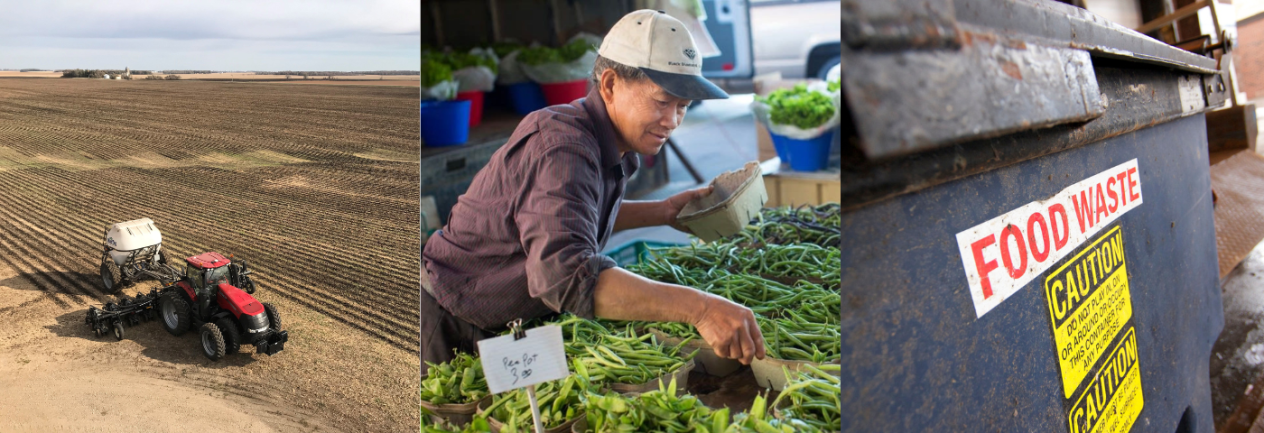
The U.S. Environmental Protection Agency (EPA) awarded Minnesota $200 million to cut climate pollution from our state’s food systems through the federal Climate Pollution Reduction Grants program. Led by the MPCA in collaboration with other state agencies, local governments, and Tribal Nations, the climate-smart food systems initiative will distribute this investment through multiple programs through September 2029. Funding opportunities will be posted under the project areas below as they are available.

Project areas
- Peatland restoration, $20 million
The Minnesota Department of Natural Resources (DNR) and the Board of Water and Soil Resources (BWSR) will facilitate programs to protect and restore more than 10,000 acres of peatlands in Minnesota, which absorb and store climate pollution.
The DNR will restore degraded peatlands on DNR-administered lands and distribute a portion of the funds to Tribal Nations for peatland restoration on Tribal Nation lands. The work will also support culturally significant food sources and provide a scalable, cost-effective model for future peatland restoration. The DNR’s Peatland Resilience Initiative webpage will be regularly updated with information about this project as well as the DNR’s other peatland resiliency work.
BWSR’s peatland restoration efforts include permanent easements on private lands under the Reinvest in Minnesota (RIM) Reserve program and restorations accomplished through agreements with other agencies and organizations. The primary goal of this work is to restore peatland hydrology to a continuously saturated and stable condition. Eligible sites must contain drained or otherwise altered wetlands that are determined to be restorable. Applications for peatland restoration are being accepted on a continuous basis. BWSR is actively seeking to partner with federal and state agencies, Tribal Nations, local governments, and conservation organizations to extend the reach of these restoration programs. More information is available on BWSR’s peatlands webpage.
Program contacts:
- Lacy Levine (Lacy.Levine@state.mn.us), DNR
- Suzanne Rhees (Suzanne.Rhees@state.mn.us), BWSR
- Climate-friendly agricultural practices, $20 million
The Minnesota Department of Agriculture (MDA) will expand three successful initiatives: the Minnesota Agricultural Water Quality Certification Program, the Soil Health Financial Assistance Program, and the Continuous Living Cover Market Development Program. These programs support farmers adopting climate-friendly agriculture practices, such as use of controlled-release fertilizers, transition from row crops to perennials, and no-till farming.
Funding opportunities include:
- Apply now - Climate friendly agricultural practices grant
- Coming summer 2026: Soil health financial assistance program grants
- Awarded: Developing markets for continuous living cover (CLC) grants
- Closed (March 30, 2026): Nitrogen enhanced efficiency fertilizer grant
Program contact: Megan Moland (Megan.Moland@state.mn.us), MDA
- Industrial innovation in food systems, $60 million
The Minnesota Pollution Control Agency’s (MPCA) Industrial Innovation in Food Systems program provides competitive grant funding to food and beverage manufacturing facilities and food system organic waste processing sites to cut climate pollution, improve efficiency, and reduce waste. Funding will help ensure that Minnesota’s food and beverage industry remains competitive, operational, and located within Minnesota.
Grantees will improve operational efficiency and reduce operating costs while lessening environmental impacts through reducing greenhouse gas emissions, criteria air pollutants, hazardous air pollutants, and/or waste. The grant programs also provide opportunities for waste processing services to reduce grid reliance and/or produce energy from waste streams.
Funding opportunities include:
- Apply now - Technical assistance and planning (TAP) grants
- Apply now - Implementation grants
Technical assistance and planning grants will help grantees identify and evaluate facility-specific efficiency projects and decarbonization efforts. Example projects may include assessments, studies, or analyses on selected processes or equipment; heat mapping; feasibility studies; techno-economic analyses; piping diagrams; energy assessments; and greenhouse gas inventories.
Implementation grants are intended to execute capital expenditure projects. Example projects may include fossil fuel equipment electrification, industrial heat pumps, combined heat and power, improved process and efficiency equipment, distributed energy resources, energy storage, fuel-switching, waste heat recovery, and anaerobic digestion of food scraps, wastewater, or manure.
In addition to these competitive grant programs, the Industrial Innovation in Food Systems program will provide $10 million in funding to Ramsey/Washington Recycling and Energy, in partnership with Dem-Con HZI Bioenergy and the Shakopee Mdewakanton Sioux Community, to construct and operate a new organics management facility in Shakopee. The facility will showcase the effectiveness of advanced industrial energy and decarbonization technologies, particularly anaerobic digestion and biochar production.
Program contact: Paul Beamer (Paul.Beamer@state.mn.us), MPCA
- Cleaner refrigerants, $10 million
The Minnesota Pollution Control Agency (MPCA) will provide grants to small businesses, supermarkets, schools, hospitals, food banks, corner stores, cold storage warehouses, and similar organizations to invest in refrigeration equipment that reduces climate pollution. This program will include two competitive grant opportunities. $8.5 million will be available for projects where existing systems are replaced with equipment using a natural refrigerant such as carbon dioxide, propane, or ammonia. Another $1.5 million will be available for smaller refrigeration projects switching to a lower global warming potential (GWP) refrigerant.
Funding opportunities include:
- Apply now - Natural refrigerants in retail food refrigeration and cold storage
- Coming in 2026: Lower GWP refrigerants grants (smaller systems eligible)
Program contact: Clark Bartelt (Clark.Bartelt@state.mn.us), MPCA
- Vehicle and equipment replacement, $20 million
The Minnesota Pollution Control Agency (MPCA) and Minnesota Department of Agriculture (MDA) will implement new programs to switch to cleaner fuels in vehicles and equipment we use to grow and transport our food.
The MPCA’s vehicle replacement program will award approximately $11 million to replace food system-related vehicles with those powered by electricity or advanced clean fuels.
The MDA’s Electric Farm Equipment Grant will award approximately $6.6 million to help farmers purchase electric agricultural equipment.
Funding opportunities include:
- Apply now - Electric farm equipment grants (MDA)
- Closed (March 27, 2026): Equipment/vehicle replacement grant (MPCA)
Program contacts:
- Cindy Osborn (Cindy.Osborn@state.mn.us), MPCA
- Michael Greene (Michael.Greene1@state.mn.us), MDA
- Prevention of wasted food and organics management, $33 million
The Minnesota Pollution Control Agency (MPCA) will administer grant and loan programs that reduce the amount of food and organic material thrown in the trash to keep valuable nutrients in circulation to feed people, livestock, and soil while preventing significant methane emissions. The prevention of wasted food and food rescue grant program will fund projects that prevent wasted food from being generated, prevent food from going to waste, or rescue edible food from disposal and redirect it for human consumption. The organics management grants programs will expand infrastructure capacity and programs for composting organic materials with a focus on wasted food and food scraps. The organics management revolving loan program will provide loans for organics management capital expenses. The food-to-livestock grant program will divert food scraps to farms for feeding livestock.
Funding opportunities include:
- Coming in 2026: Food-to-livestock grant
- Coming in 2026: Organics management programs grant
- Coming in 2026: Organics management revolving loan program
- Closed (April 15, 2026): Organics management composting infrastructure grant
- Closed (April 28, 2026): Prevention of wasted food and food rescue grant
Learn more about:
- MPCA’s prevention of wasted food and food rescue work
- MPCA’s 2024 organics management grant awards (a non-CSFS program)
Program contact: Katie Niemeyer (Katie.Niemeyer@state.mn.us), MPCA
- Food sovereignty and vibrant local food economies, $35 million
The Minnesota Pollution Control Agency (MPCA) and the Minnesota Department of Health (MDH), in collaboration with local public health, have established regional food networks statewide to improve food security, expand local food economies, strengthen food sovereignty, and reduce climate pollution in Tribal and local food systems. Tribal food sovereignty funds will be available to support planning and implementation of projects within Tribal Nations and American Indian communities in urban areas. Local food systems grants will be available to support community-driven strategies for decarbonization of local food systems across the state.
Funding opportunities include:
- Available now for eligible Tribes: Tribal food sovereignty non-competitive grants
- Apply now - Food sovereignty grants, competitive
- Coming in 2026: Local food systems grants, competitive
- Closed (July 18, 2025): Regional food coordination
- Closed (Jan. 28, 2026) Assessment of local and regional food systems (MDH)
Program contacts:
- Regional food networks and local food systems assessment: Sadie Gannett (Sadie.Gannett@state.mn.us), MDH
- Tribal food sovereignty and local food systems grants: Valerie Gamble (Valerie.C.Gamble@state.mn.us), MPCA

Webinars
The Climate-Smart Food Systems initiative held a one-year update webinar in December, building on the information in the kickoff event in October 2024.
This project has been funded by the EPA under assistance agreement 66.046 to the Minnesota Pollution Control Agency. The contents of this webpage do not necessarily reflect the views and policies of the EPA.