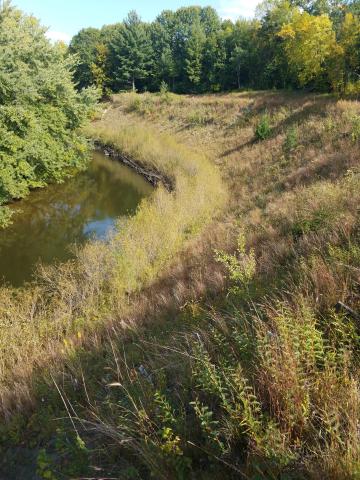
Water quality trading is a market-based tool for achieving improved water quality. To offset its pollutant discharges, an entity required to control a pollutant in a watershed can trade water quality credits with another entity in the same watershed to lower its pollution-control costs. Water quality trading can enhance pollution reduction efforts while offering flexibility and cost savings to regulated municipalities and industries.
Consider this scenario: To meet its permit requirements, a city's wastewater treatment plant must reduce the amount of phosphorus in its discharges to the local river. Achieving these reductions from the facility will require plant upgrades and increased operational costs. Meanwhile, streambank erosion is threatening to wash out the access road to an upstream farm. The city makes an agreement with the landowner to finance three projects:
- stabilize the eroding streambank next to the access road
- install a new fence to prevent the landowner's cattle from accessing the stream
- provide an alternative water source for the livestock
These projects cost much less than the wastewater treatment plant upgrades. Riverbank stabilization and keeping cattle away from the river will keep phosphorus and sediment out of the water. The phosphorus reduction resulting from the projects is calculated and converted to water quality trading credits to offset a portion of the wastewater treatment plant's phosphorus output. The results? The city meets its clean-water goals at a reduced cost, the farmer’s access road is secured, and phosphorus levels in the river are reduced. The streambank improvements have the added benefit of reducing cloudiness in the river from sediment, which can be harmful to fish.
This scenario is just one possibility. Another might be that the city purchases credits from another city with a wastewater facility that is capable of reducing its phosphorus output below what is currently required in its permit, thus having excess phosphorus "credits" to trade. Learn about other possibilities on the Water quality trades in Minnesota page, which lists all the trades that have been arranged in Minnesota.
Water quality trading has a number of benefits, including:
- giving water-permit holders cost effective and flexible options to meet permit requirements, even when their permitted activities are expanding (e.g., a city’s wastewater discharge is increasing due to population growth)
- generating income for entities that are able to reduce water pollution
- encouraging reductions of non-regulated sources of pollution and helping the state achieve greater environmental benefits than with regulatory measures alone
- incentivizing approaches that have benefits beyond improving water quality, such as wetland and wildlife habitat restoration and carbon sequestration
Pilot project
In 2021, the MPCA worked with the Minnesota Department of Agriculture and Board of Water and Soil Resources to convene local partners in the North Fork Crow River Watershed and discuss challenges and opportunities related to water quality trading in the area. A report outlines the resulting recommendations:
The trading process
Water quality trades are implemented and enforced through MPCA-issued permits, so initiating a trade begins with contacting the agency to evaluate trading opportunities. The details of each trade will vary based on the trading partners and their circumstances. To facilitate increased trading, the MPCA has created a guide to the process of developing water quality trades in Minnesota:
Some of the major considerations of water quality trading include:
- Trade boundaries — Water quality permits are written to protect the bodies of water downstream of a permitted facility's discharges. Any trading partners' activities must affect and work to offset pollution in the same bodies of water. This will limit the possible partnerships for trading.
- Calculating water quality trade credits — The value of water quality trading credits is based on the estimated reductions of a pollutant to the targeted body of water. Determining the value requires three steps:
- estimate the amount of the pollutant reaching the targeted body of water before the pollutant-reduction project is implemented
- estimate the expected amount of pollution reduction from the completed project
- apply a trade ratio to the transaction to account for uncertainty in pollution reduction amounts and ensure net water quality benefits
- Project planning — Permit holders proposing water quality trades must develop water quality trading plans that outline several elements, including:
- the boundaries in which the trade is occurring
- the amount of pollutant being traded
- how trading credits will be calculated
- methods for verification and maintenance of trade components
Trades must include legal agreements between the trading entities setting the conditions of the trade. Water quality trading plans must be submitted with permit applications and approved by the MPCA.
The process starts by contacting the MPCA to evaluate trading opportunities. Email us at the address at left to ask questions or to discuss how water quality trading can work for you.
Resources
- Water quality trading (U.S. EPA) — Features a range of resources including an FAQ and a presentation on using market-based mechanisms to improve water quality
- The Water Quality Trading Toolkit (Association of Clean Water Administrators and Willamette Partnership)
- Building a water quality trading program: Options and considerations (Willamette Partnership)
- State trading programs compilation (The Environmental Trading Network)