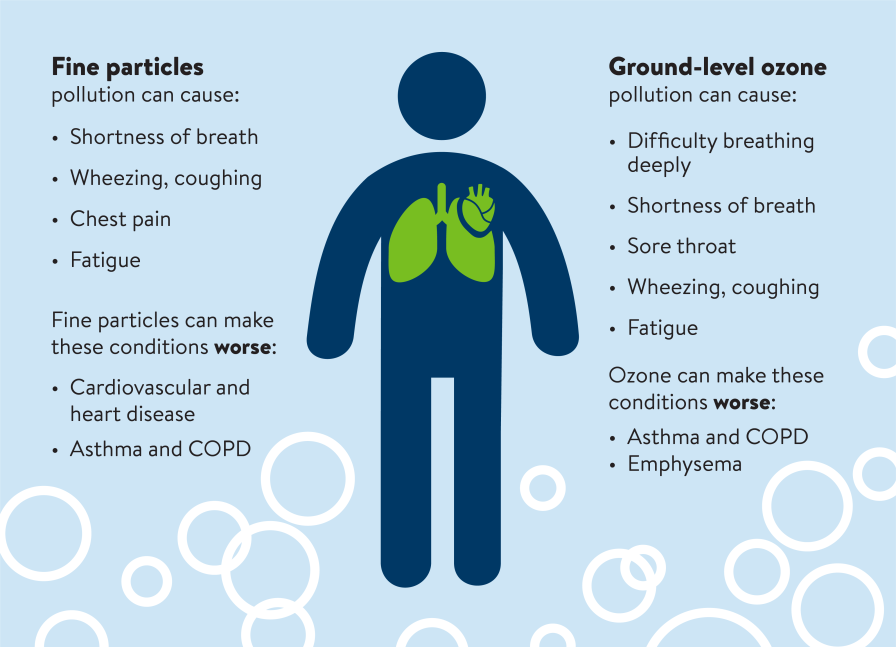
Exposure to air pollution can affect everyone’s health. When we breathe in air pollutants, they can enter our bloodstream and contribute to coughing or itchy eyes and cause or worsen many breathing and lung diseases, leading to hospitalizations, cancer, or even premature death.
Minnesota’s air currently meets all federal air quality standards. However, even levels of air pollution below the standards can affect people’s health, including levels currently found in parts of Minnesota.
No matter where you live, you can be exposed to air pollution from vehicle exhaust, smoke, road dust, industrial emissions, pollen, gas-fueled yard equipment, chemicals we use in our homes, and other sources.
Both short-term and long-term exposure to air pollutants can cause a variety of health problems. For people with asthma or chronic obstructive pulmonary disease (COPD/emphysema or chronic bronchitis), air pollution can make it harder to breathe, trigger asthma attacks, or cause wheezing and coughing. Air pollution also increases the risk of respiratory infections, heart disease, stroke, and lung cancer, and more severely affects people who are already ill.
People’s health risks from air pollution vary widely depending on age, location, underlying health, and other factors. Many studies show that low-income communities and minority populations are disproportionately exposed to air pollution and are more vulnerable to adverse health impacts. Data from the Minnesota Department of Health show disparities in heart and lung disease by age, race/ethnicity, income level, and geography. Minnesota also has significant disparities in asthma prevalence by race/ethnicity. The asthma hospitalization rate among Twin Cities children is more than 50% higher than among children living in Greater Minnesota.
Populations most at risk of health problems related to air pollution:
- people with lung diseases, such as asthma, chronic bronchitis, emphysema, and chronic obstructive pulmonary disease
- infants and young children
- people who work or exercise outdoors
- adults over 65
- people with a cardiovascular disease
- people in poverty; people who lack access to health care
- people who smoke or are exposed to second-hand smoke
- people working in occupations where there is high exposure to contaminated air
- people who spend a lot of time near busy roadways
The MPCA works to reduce emissions from all sources of air pollution, especially striving to reduce exposures in overburdened communities and work toward environmental justice.
Wood smoke
People who frequently breathe wood smoke are at risk for serious adverse health effects. Wood smoke contains wood tars, gases, and soot, as well as chemicals like carbon monoxide, dioxins, volatile organic compounds (VOCs), and fine particles.
Short-term exposure to fine particles in the air can aggravate lung disease, trigger asthma attacks and acute bronchitis, and may also increase the risk of respiratory infections. Scientists have also linked short-term exposures to heart attacks and abnormal heartbeats. Over time, breathing fine particles in the air increases the chances of developing chronic obstructive lung disease (COPD), chronic bronchitis, cardiovascular disease, or lung cancer. In high concentrations, wood smoke can permanently damage lung tissue.
Indoor air
We tend to think of air pollution as something outside, but the air inside homes, offices, and other buildings can be more polluted than outdoor air. On average, Americans spend approximately 90% of their time indoors, where the concentrations of some pollutants are often two to five times higher than outdoor concentrations. Moreover, people who are most susceptible to the effects of pollution (e.g., the very young, older adults, people with cardiovascular or respiratory disease) tend to spend even more time indoors.
Common indoor air pollutants include radon, smoke, and lead dust. Carbon monoxide from a faulty furnace, mold from damp walls, or volatile organic compounds from a newly painted room also contaminate indoor air. Pollutants such as fine particles from candles or fireplaces (or from the outdoors) also affect our health.
Biological pollutants — such as mold, pollen, animal dander, dust mites, and cockroaches — may trigger breathing problems, allergic symptoms, or asthma attacks. Tobacco smoke contains some 200 known poisons, such as formaldehyde and carbon monoxide, and at least 60 chemicals known to cause cancer. Radon is the second leading cause of lung cancer in the U.S.
For details on common indoor air pollutants, asthma, indoor air quality in schools, and more, visit Air quality, climate & health (Minnesota Department of Health).
Take steps to protect your health
- Know when air quality is unhealthy — Check out the MPCA Air Quality Index and sign up for air quality forecasts and alerts.
- Adjust outdoor physical activities when air quality starts to reach unhealthy levels — Check out the Minnesota Outdoor Air Quality Guidance for Schools and Child Care (available in English and Español).
- Protect yourself while driving — Close your windows when you're in traffic and set your ventilation system to recirculate the air to avoid breathing vehicle exhaust. Choose driving routes that are less traveled, especially by diesel vehicles.
- Avoid exposure to pollutants — Keep away from wood smoke, vehicle exhaust, tobacco smoke, and other sources of airborne particles, where possible. Avoid prolonged outdoor exertion near busy roadways or on days when the air quality is poor.
Science and data
Cumulative health effects
When projects or actions are proposed that might affect pollution levels in an area, communities want to know how it will affect human health when combined with other pollutants and stressors in their community. Many large and small sources of air pollution contribute to an individual’s exposure. The MPCA developed a risk-screening tool called MNRISKS to help understand this cumulative impact of air pollution on Minnesotans. MNRISKS is refreshed every three years when air toxics emissions inventory data is released.
MNRISKS compares air pollution levels against health benchmarks to estimate the potential for negative health effects. A health benchmark is an amount of air pollution that is unlikely to result in health effects after a specific exposure period.
Higher scores mean higher risks, but don't necessarily mean that health effects are occurring in an area. MNRISKS helps regulators prioritize emission reduction activities, air monitoring locations, and other efforts to improve air quality. These may include focusing on specific pollutants or geographic areas, double-checking estimates of air emissions provided by permittees, and identifying disproportionate impacts to specific populations.
- Environmental justice map – Click on the “air pollution score” tab to see MNRISKS scores around the state.
Air toxicity benchmarks and risk assessment
We use specific benchmark values for risk assessment. We compare air concentrations of pollutants to these health benchmarks to assess for potential health effects.
- Air toxicity values
See “ToxValues” tab