Rain and snow melt run over the many hard surfaces in urbanized areas — roads, sidewalks, driveways, parking lots, roof tops, etc. — and pick up pesticides, fertilizers, oils, metals, road salt, sediment, trash, and other pollutants and carry them into storm drains. Storm drains discharge directly into lakes rivers, streams, and wetlands (the water is not treated first) so stormwater runoff is a leading source of water pollution.
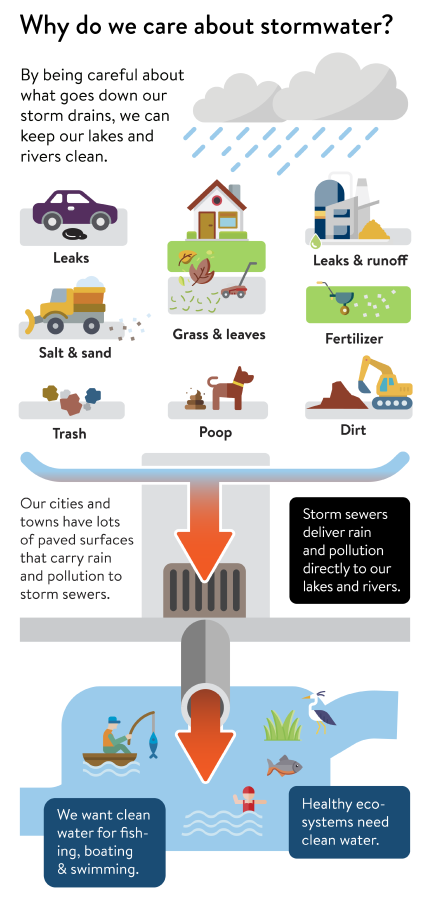
In addition, stormwater runoff from hard urban surfaces travels quickly and in large quantities, which results in damage to rivers, streams, and wetlands; destruction of aquatic habitats; and elevated pollutant levels reaching surface waters. Pavement and other hard surfaces also prevent stormwater from soaking into the ground and recharging groundwater. Local public entities that own or operate municipal separate storm sewer systems (MS4) play a key role in preventing stormwater runoff from harming Minnesota’s valuable water resources.
What is an MS4?
A municipal separate storm sewer system (MS4) is a conveyance or system of conveyances (roads with drainage systems, municipal streets, catch basins, curbs, gutters, ditches, man-made channels, storm drains, etc.) that is also:
- owned or operated by a public entity (which can include cities, townships, counties, military bases, hospitals, prison complexes, highway departments, universities, sewer districts, etc.)
- designed or used for collecting or conveying stormwater
- not a combined sewer
- not part of a publicly owned treatment works
MS4s in Minnesota must satisfy the requirements of the MS4 general permit if they are at least one of the following:
- located in an urbanized area as determined by the latest Decennial Census by the Bureau of the Census
- owned by a municipality with a population of 10,000 or more
- have a population of at least 5,000 and the system discharges to specially classified bodies of water.
Minnesota Rule 7090 establishes criteria and a process for designating future MS4s.
The MS4 general permit is designed to reduce the amount of sediment and other pollutants entering state waters from stormwater systems. Entities regulated by the MS4 general permit must develop a stormwater pollution prevention program and adopt best practices. Learn more on the Complying with the MS4 general permit page. A general permit covers multiple entities with similar operations and types of discharges, and allows for faster and more efficient permitting compared to issuing individual permits.

Stormwater and total maximum daily loads
A total maximum daily load (TMDL) is the amount of pollutant that a body of water can receive and still meet water quality standards. After a TMDL has been set for a body of water, NPDES permittees that discharge to that water (including municipal stormwater systems) are assigned a wasteload allocation that specifies the amount of each pollutant (a portion of the TMDL) that the permittee can discharge.
Wasteload allocations approved by the U.S. EPA prior to the effective date of the MS4 General Permit must be addressed by permittees in their stormwater pollution prevention program documents. Applications for general permit coverage must include information on applicable wasteload allocations and how the permittee will move toward complying with them over the five-year permit term.
- see details of EPA-approved wasteload allocations for permitted MS4s in Minnesota
- see the Minnesota Stormwater Manual for TMDL-related permit requirements and technical guidance

MS4 mapping tool
Find regulated MS4s, outstanding resource value waters, drinking water supplies, and impaired waters. Click on map elements for more information.
Stormwater financial assistance
The MPCA has various opportunities for obtaining grants or loans for stormwater projects in Minnesota. Visit the following MPCA webpages for information on water-related financial assistance:
MS4 stormwater program staff
| Supervisor | Duane Duncanson (651-757-2323) |
| Municipal stormwater policy | Cole Landgraf (651-757-2880) Nick Nistler (218-302-6670) |
| Permit writer | Cole Landgraf (651-757-2880) |
| Technical assistance and compliance enforcement | Kong Fyten (651-757-2447) Kevin Strauss (507-206-2624) Ken Zeik (651-757-2301) |
| TMDL/MS4 Permit technical assistance | Anna Bosch (218-316-3929) |
| Application processing | Contact MPCA staff assigned to your MS4 |