Product Stewardship Initiative for Electronics
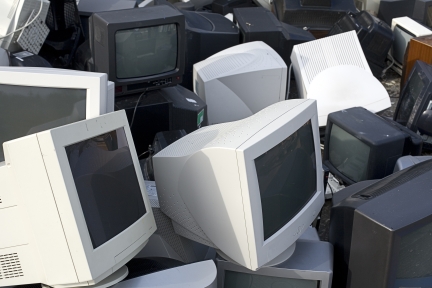
Minnesota has long been concerned about the growing number of electronic products
entering the waste stream, particularly those containing cathode ray tubes
(CRTs), such as computer monitors and televisions.
- July 2007: Minnesota Electronics Recycling Act. A new Minnesota law goes into effect on recycling "video display devices" from households: televisions, computer monitors, and laptop computers. To sell these devices to households in Minnesota, manufacturers will have to register with the state and pay a fee, as well as collect and recycle "covered electronic devices" to meet recycling goals set out in the law. Learn more »

- July 2006: The state enacted a disposal ban on CRT-containing devices.

- 2005-2006: Minnesota participates in the Midwest Regional Electronic Waste Recycling Policy Initiative.

- 1999: Minnesota named electronic products containing CRTs as a priority for product stewardship
initiatives.
Product stewardship means that everyone involved in designing, manufacturing,
selling and using products takes responsibility for the environmental
impacts at every stage of a product's life. In particular, product stewardship
asks manufacturers to share in the financial and physical responsibility
for recovering and recycling products when people are done using them.
When manufacturers share in the costs and responsibility for collecting
and recycling products, they have an incentive to design products differently,
to reduce toxic constituents and increase the use of recycled materials.
Minnesota, along with a growing number of other states, is asking electronics
manufacturers and retailers to help establish and fund collection and
recycling programs for old electronic products. In initiatives at both
the state and national levels, the Product Stewardship team advocates programs that achieve
the following criteria:
- Convenient, accessible collection opportunities provided throughout
the state;
- Costs of collection and recycling are incorporated into product prices,
so that recycling programs are not funded with tax dollars, and so that
consumers are not charged a drop-off fee for recycling;
- Reuse and recycling of old electronics increases over time, with measures
of progress such as recycling goals and monitoring to assess progress.
- Efficient, effective programs that seek to lower costs while maintaining
environmental protection.
See Minnesota Electronics Initiatives for
more detail on the partnerships and projects underway to address
the increasing disposal of old electronics using a product stewardship
approach.
Why Electronics? Increasing volume, toxicity concerns, recycling
potential
Volume
According to a 1999 study by the National Safety Council, 20.6 million
computer monitors became obsolete in 1998, and only 11% of those were
recycled. NSC believes the lifespan of a personal computer has decreased
from 4-5 years down to just two years, with nearly 500 million computers
becoming obsolete between 1997 and 2006. NSC anticipates that three-quarters
of all computers ever bought in the U.S. remain stockpiled in storerooms,
attics, garages, and basements. Sweeping changes in technology, such as
the anticipated conversion to digital broadcast television, shorten the
useful lives of electronic devices and promise to increase the amount
of electronics in waste.
Toxicity
The rapidly growing number of computers, televisions and other electronic
items becoming obsolete means that a substantial quantity of hazardous
and toxic materials may also enter the waste stream. Electronic products
contain lead and other heavy metals that are toxic if released into the
environment. CRTs are considered the single largest source of lead in
Minnesota's municipal waste, containing 5-8 pounds of lead per unit.
There is a growing body of research into the toxicity of electronic components
and materials.
- Researchers at Jackson State University (Mississippi) tested printed wire boards (PWB) from personal computers using the toxicity characteristic leaching procedure (TCLP). Among the heavy metals contained in these components, lead was found to be the predominant element that causes the toxicity characteristic of the PC components, with concentrations 30-100 times the regulatory level of 5 mg/L for classifying a waste as hazardous. The motherboard in a PC contributed 50–80% of the total lead that could leach out from all the PWBs in the PC under the TCLP test conditions. Findings were presented in this article:
Journal of Environmental Engineering (April 2006)
- The University of Florida has completed research with CRTs, testing
electronic waste to see if lead leached out in sufficient quantity to
classify CRTs as a toxicity characteristic (TC) hazardous waste. Results
indicated that color CRTs, in a majority of cases, exceeded the TC limit
for lead. Additional devices are now being tested to determine whether
they qualify as TC hazardous wastes. The findings were presented in
this article:
Environmental
Science & Technology #34 (2000).
Follow-up research was conducted, with TCLP was conducted on a number
of other electronic devices, including computer mice, keyboards, VCRs,
printers, and laptop computers.
Leaching
of Hazardous Chemicals from Discarded Electronic Devices (July 2004,
Townsend, et al)
- Research by the California Department of Toxic Substances Control’s
Hazardous Materials Laboratory (HML) found that laptops and LCD monitors
exceed that state’s hazardous waste thresholds. According to a
recent report released by HML, preliminary findings indicated that all
devices tested exceeded at least one hazardous waste measure. Copper
and lead exceeded their limits. Four laptop computers and four LCD monitors
of different brands and models were analyzed.
SB20 Report:
Determination of regulated elements in discarded laptop computers, LCD
monitors, Plasma TVs and LCD TVs ( 400Kb)
- Brominated flame retardants (BFR) are used in the plastic casings
and circuit boards of electronic equipment such as computers and TVs.
BFRs are suspected endocrine disrupters, and can impact human health.
Two common additives used in flame retardants, polybrominated diphenyl
ethers (PBDE) and polybrominated biphenyls (PBB), can leak out of electronic
products and can persist in the environment for years. More information:
www.svtc.org
Research conducted by the Computer Take-Back Campaign (CTBC) and Clean
Production Action (CPA) found BFRs in dust on the surface of computers.
Dust samples were taken from computers in public places, such as university
computer labs and legislative offices, in eight states. In all, sixteen
samples of dust were taken from the central processing units (CPUs)
and monitors of computers; PBDE residues (a class of fire retardant
chemicals) were found on every computer sampled. Learn more: www.computertakeback.com/the_problem/bfr.cfm
Recycling value
Electronic products contain valuable glass, metals and plastics that
can be used to make new products. Several electronics manufacturers have
started using recycled plastics and glass from old electronics in their
new products, as well as designing new products that can be more easily
disassembled for recycling.
In 1999, a statewide electronics collection and recycling project was
conducted in Minnesota. The project yielded several key findings on recycling
methods and markets:
- Plastics recovered from old television sets were analyzed and were
found to meet quality specifications for use in new electronic products.
- Recycling the old CRT glass into new CRT glass is less expensive than
smelting the CRT glass to recover the lead.
|
Initiatives
in other states
|