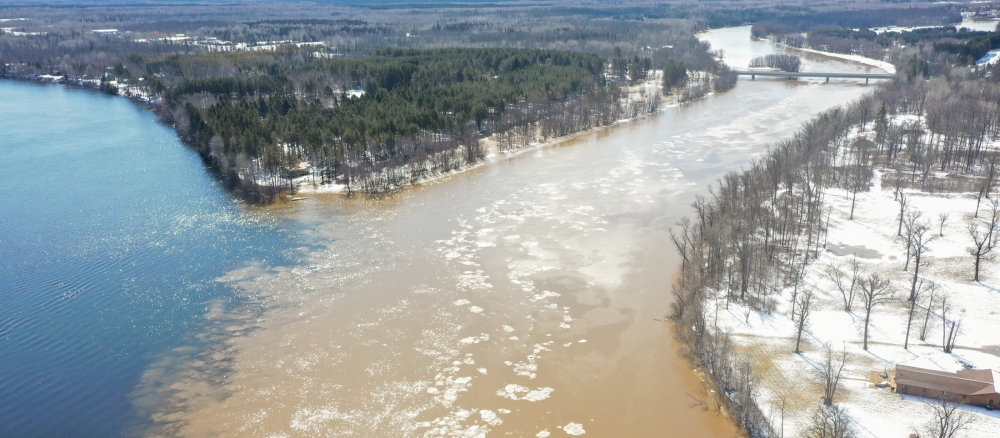
Little Fork River Watershed
Overview
Watershed at-a-glance
The Little Fork River watershed is 1,179,520 acres, the main stem flowing 160 miles through north central St. Louis County and heading northwest into Koochiching County. It flows more northerly until it reaches its confluence with the Rainy River about 11 miles west of International Falls. There are no large cities in this remote watershed. Cook’s population is 667 and Little Fork, 874.
Monitoring and assessment report
Little Fork River Watershed Monitoring and Assessment Report.
| Hydrologic Unit Code (HUC) | 09030005 | [More Info] |
| Intensive monitoring start year | 2008 | [More Info] |
| Major lakes | Major rivers and streams |
|---|---|
|
Sturgeon, Big Rice, Sand, Nett Lake |
Little Fork, Nett Lake River, Dark, Lost, Beaver Creek |
Characteristics
The main resource concerns in the watershed are wind/water soil erosion, wetland management, surface water quality, flood damage reduction, and wildlife habitat. Many of the resource concerns relate directly to agricultural activities in the region that have resulted in fragmentation and increased pollutant loadings to surface waters.
What's being done
In 2006, the MPCA published “Effects of Historical Logging on Geomorphology, Hydrology, and Water Quality in the Little Fork River Watershed.” In 2008, the intensive watershed monitoring 10-year cycle started on this watershed. Four river segments have been identified as impaired for biological integrity. Stressor identification is ongoing on these segments. A TMDL process will be forthcoming.
MPCA's watershed approach: Since 2007, the MPCA and its partners have begun implementing a 10-year rotation for watershed restoration plans to address Minnesota's waters at the major watershed level.

[+] See large map
Watershed News
Is Minnesota's water quality important to you?
If so, take this quick survey. Less than 5 minutes of your time will help us give you the information you want about Minnesota's water quality.
New monitoring and assessment report available
In 2008, the MPCA began an intensive watershed monitoring effort of the Little Fork River watershed's surface waters. For more information on the results of that monitoring effort, download the Little Fork River Watershed Monitoring and Assessment Report.


Restoration and protection
The restoration and protection process
The MPCA and partner organizations evaluate water conditions, establish improvement goals and priorities, and take actions designed to restore or protect water quality on a 10-year cycle.
Monitoring and assessment
Projects in this watershed to test water quality conditions and determine whether our lakes, rivers, and wetlands are meeting state water quality standards. [More info]
| Project Name | Status |
|---|---|
| 1st WQ Inventory of Itasca County Lakes |
|
| Itasca County Watershed Assessment |
|
| Little Fork River Assessment Monitoring MN Wtrs |
|
Data available for this watershed
Lakes and stream segments with condition and monitoring information
Lakes and streams are divided into "assessment units" for monitoring.
Impairments in this watershed listed by lake or stream segment
Generally, a waterbody has an impairment when it exceeds a particular pollutant standard.
Strategy development projects
Projects in this watershed that establish federal- or state-required plans for restoring water quality for impaired waters, or protecting high-quality waters. [More info]
| Project Name | Status |
|---|---|
| Little Fork River Major Watershed WRAP Strategy |
|
| Mercury Pollutant Reduction Plan |
|
Implementation activities
Projects in this watershed to put water restoration or protection measures in place, ranging from best management practices to reduce runoff from fields or streets, to fixes to wastewater treatment facilities, to education activities for citizens and landowners. Implementation projects are supported by local, state and federal government sources, including Minnesota's new Clean Water Fund.
Our partners in the watershed are continually involved in these kinds of activities. See Contacts tab.
| Project Name | Status |
|---|---|
| Lake of the Woods Quality Forum |
|
| Rainy River/Lake of the Woods Forum 2008 |
|
Maps
Watershed Map
Many of Minnesota’s lakes and streams do not currently meet water-quality standards because of pollution such as excess sediment or nutrients, bacteria or mercury. These waters are considered “impaired.” For more information, visit the impaired waters page.
The toggles show impaired waters and monitoring stations. Click on a site for more information.
Impairments in this watershed, listed by lake or stream segment
Generally, a waterbody has an impairment when it exceeds a particular pollutant standard.


