Wetland monitoring and assessment
Wetlands are a prominent feature of Minnesota's surface waters, but it is not well understood how pollutants and physical alterations impact wetland quality. The MPCA has actively been developing methods and building capacity to improve our ability to monitor and assess wetlands.
The goals of this effort are ultimately to protect and restore the integrity of Minnesota's wetlands by providing scientifically valid information to make informed management decisions and monitor the status and trends of wetland quality.
State wetland monitoring strategy
Minnesota's wetland policy is no net loss in the quantity, quality, and biological diversity of wetlands. A multi-agency effort was undertaken from 2004-2006 to define a framework to measure Minnesota’s progress in meeting this goal.
The overall goal of the Comprehensive Wetland Assessment, Monitoring, and Mapping Strategy for Minnesota (CWAMMS) was to develop a broadly understood, scientifically sound strategy for monitoring and assessing the status and trends of wetland quantity and quality statewide.
Recommendations
Three general approaches were recommended:
- implement status and trends surveys of wetland quantity and quality.
- develop an integrated accounting system for wetland permitting and conservation activities.
- update the National Wetland Inventory (NWI) in Minnesota.
Through 2011, a number of activities have been initiated to meet the CWAMMS recommendations:
- In 2006, the Department of Natural Resources (DNR) began a statewide remote sensing survey to monitor the status and trends of wetland quantity. The first cycle was completed in 2010, and results will be reported every three years.
- The MPCA began a statewide wetland quality survey of depressional wetlands in 2007 and expanded monitoring to all wetland types in 2011. See Wetland quality status and trends monitoring
- In 2010, the DNR began the first phase of NWI updates in Minnesota.
- The U.S. Army Corps of Engineers has launched RIBITS, an improved mitigation and wetland bank accounting system that the Board of Water and Soil Resources is using for wetland bank accounting.
Wetland quality status and trends monitoring
Using probabilistic, or random, surveys to track the status and trends of wetland quality is a central wetland monitoring activity at the MPCA. Overall wetland quality can be tracked by randomly sampling a small number of sites; much like a political or marketing poll where results of a population can be obtained by surveying a limited number of individuals. Two statewide probabilistic wetland quality surveys are underway to provide estimates of the baseline status of wetland quality in Minnesota. These surveys will be repeated periodically to estimate wetland quality trends and ultimately, help determine whether Minnesota is meeting the no net loss wetland policy. For more information: Wetland quality status and trends monitoring
Biological assessment methods and sampling protocols
A primary focus of wetland monitoring and assessment at the MPCA has been biological monitoring. Aquatic organisms are fully exposed to human-caused stressors such as hydrological changes that disrupt natural water dynamics; excess sediment and nutrient loading; chemical pollution; and encroachment by invasive species. Biological communities typically respond in predictable patterns to stressors, integrating their effects over time, and can represent the condition of the aquatic environment.
Since the mid-1990s, the MPCA has worked to characterize wetland invertebrate and plant community responses across gradients of human stressors. This work has resulted in the development of invertebrate and plant Indices of Biological Integrity (IBIs) for depressional wetlands (i.e., wetlands within a depression in the landscape that typically have standing open water fringed by an emergent marsh plant community) for each of the major ecoregions in Minnesota. More recently, work has been completed to increase our capacity to monitor all wetland types in the state by focusing on plants and using the floristic quality assessment.
Reports and protocols
- Floristic quality assessment for Minnesota wetlands (May 2007)
-
Development and Validation of Indices of Biological Integrity (IBI) for Depressional Wetlands in the Temperate Prairies Ecoregion (wq-bwm6-01) -
Indexes of Biological Integrity for Large Depressional Wetlands in Minnesota (wet-report-largewetland) -
Reconnaissance Procedures For Depressional Wetland Monitoring Sites (wq-bwm1-05) -
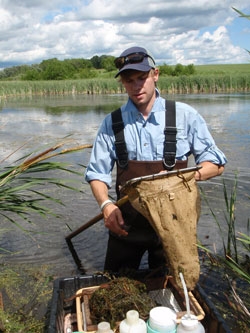
Macroinvertebrate Community Sampling Protocol for Depressional Wetland Monitoring (sop-wetland-invert) -
Water Chemistry (wq-bwm5-01) -
Aquatic Plant Community Sampling Protocol for Depressional Wetland Monitoring Sites (wq-bwm3-01)
Watershed monitoring
Following the passage of the Clean Water Legacy Act (CWLA), the MPCA adopted a general framework to conduct monitoring, assessment, listing, and implement water quality improvement activities for lakes and streams on a rotating major watershed basis.
-
Watershed Approach Fact Sheet Summary (wq-s1-26)
As an integral part of Minnesota's water resources, wetland monitoring information will be an essential component as efforts to protect and restore lakes and streams are implemented. The MPCA is currently incorporating wetland monitoring activities into the watershed approach to support water quality decisions.
This will include:
- Status and trends monitoring of wetland quantity and quality by major watershed.
- Natural background determinations for more accurate stream and lake assessments.
- Linking wetland condition and ecosystem services to lake and stream impairments.
- Identifying opportunities for wetland protection and restoration for water quality improvements.
More information on the MPCA's Water Quality Monitoring Strategy:
Impaired waters assessment
The MPCA has assessed a limited number of depressional wetlands for Aquatic Life Support using the plant and invertebrate IBIs. This has resulted in listing 14 wetlands on the 303(d) list of Impaired Waters through 2011. Efforts are underway to incorporate impaired wetlands in to the Total Maximum Daily Load (TMDL) process. For more details on these impaired wetlands and the rationale for listing wetlands on the Impaired Waters List:
-
2008 Wetland Assessment Documentation (wq-iw12-05-08)
Long-term wetland monitoring
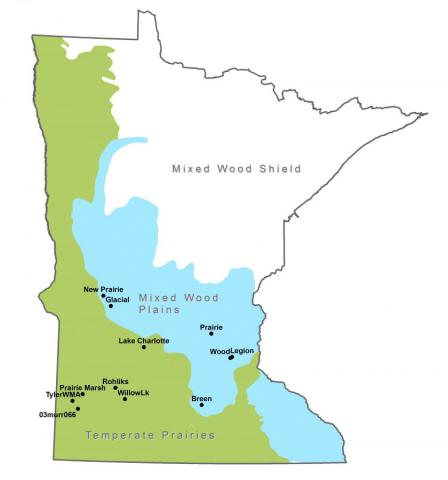
The MPCA has been regularly sampling a small set of depressional wetlands located within relatively stable land use settings to study whether large scale factors (e.g., climate, atmospheric deposition) are affecting the condition of Minnesota's wetlands. More information and site reports are available on Long-term wetland monitoring.
Citizen wetland monitoring
The Wetland Health Evaluation Program (WHEP) is a citizen volunteer wetland monitoring program that is focused on educating the public on wetland ecology and quality issues; as well as, providing local governments with wetland planning information. WHEP is currently active in Dakota and Hennepin counties, with a number of cities sponsoring local monitoring teams. The MPCA was instrumental in developing the WHEP sampling techniques and analytical tools, which were adapted from the depressional wetland invertebrate and plant IBIs. The comprehensive Citizen Plant Assessment Guide is available here:
-
1984 (clmp-annualreport-1984)
WHEP volunteer information, activities, and training videos are available on the WHEP website.
For more information
For more information about wetland monitoring and assessment at the MPCA, contact Michael Bourdaghs at 651 757-2239