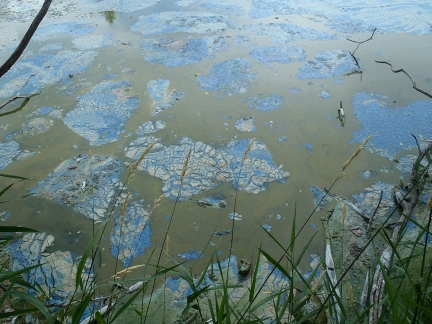
When temperatures climb and the summer sun beats down, conditions are ripe for Minnesota lakes to produce harmful algae blooms, some of which can be harmful to pets and humans. When in doubt, best keep out!
What are blue-green algae?
Though often referred to as algae, blue-green algae are not algae at all, but types of bacteria called cyanobacteria. They are normally present in bodies of water and common in Minnesota. This type of bacteria thrives in warm, nutrient-rich water. When conditions are right, the blue-green algae can grow quickly forming “blooms.” Certain varieties of blue-green algae can produce toxins that are linked to illness in humans and animals.
What do blue-green algal blooms look like?
Blue-green algal blooms are often described as looking like pea soup or spilled green paint. However, blooms aren’t always large and dense and can sometimes cover small portions of the lake with little visible algae present. Blooms can also produce a swampy odor when the cells break down.
A couple of easy tests can tell you if the green stuff you're seeing in your body of water is likely to be blue-green algae.
What are harmful algal blooms?
Blue-green algae blooms are harmful when they produce toxins that can make humans and animals sick. Most blooms are not harmful. You can't tell by looking at a bloom if it is harmful or not.
When do harmful algal blooms occur?
Blue-green algae prefer warm, calm, sunny weather and water temperatures higher than 75°F. Blooms usually occur during summer and early fall, but can occur other times of the year, if conditions are right.
Where are harmful algal blooms found?
Harmful algae can be found everywhere in Minnesota, but thrive in warm, shallow, nutrient-rich lakes. They will often be found on the downwind side of a lake or in a secluded bay or shoreline.
What are the possible health effects?
You can become sick if you swallow, have skin contact with, or breathe in airborne water droplets while swimming, boating, waterskiing, tubing, bathing, or showering in water that has harmful algae or if you drink water that contains algal toxins. If you become sick, you might experience vomiting, diarrhea, rash, eye irritation, cough, sore throat, and headache. Symptoms generally begin hours to two days after exposure.
Levels of risk
The activities that put you in contact with the water — and the amount of time you spend on them — will affect your exposure to algae toxins. Children will generally be more affected than adults.
| Activities | Level of exposure to algae toxins |
|---|---|
| Drinking (incidental or intentional) | Highest |
| Swimming, diving, water skiing, windsurfing, tubing, paddle boarding | High |
| Canoeing, kayaking, sailing, personal watercraft | Moderate |
| Fishing, boating, fish consumption | Low |
How can I reduce my risks from harmful algae blooms?
During water recreation
Avoid or minimize recreating in waters that appear to have a blue-green algae bloom; if you do come in contact with algae-laden water, wash with fresh water afterwards.
Blue-green algae in sources of drinking water
Avoid using untreated lake or river water for drinking, cooking, and brushing teeth, especially for infants and small children. Boiling water will not destroy algae toxins and could actually increase toxin levels. Simple treatment options are also not effective; multiple treatment steps are typically needed to remove algae toxins.
Water that may be contaminated can be used for handwashing, bathing, washing dishes, or laundry, though it may irritate skin. Young children should be supervised when swimming to prevent them from swallowing water, and should be rinsed with uncontaminated water afterwards. Items that go into the mouths of infants and young children (i.e., teething rings, nipples, bottles, toys, dishes and silverware) should be rinsed with uncontaminated water if they are washed in contaminated water.
Eating fish from algae-laden waters
Toxins from algae can accumulate in the entrails (guts) of fish and occasionally in the muscle (fillet). Levels in fish depend upon the severity of the bloom in the area where the fish are caught.
In general, fish that are caught in areas of a waterbody where major blue-green algae blooms are occurring may be safe to eat, as long as the guts are discarded. However, it's uncertain how much algae toxin can accumulate in fillets, so anglers may want to wait a week or two after algae blooms are over before fishing and eating fish from waters where a bloom is occurring.
Can animals be affected?
Pets, especially dogs, are susceptible to harmful algae because they are relatively small and tend to swallow more water while swimming and playing (e.g., retrieving a ball from the water). Dogs may ingest algae if they lick their coats after leaving the water. They are also less deterred by green, smelly water that may contain harmful algae.
Reduce your animal's exposure to blue-green algae:
- don't let them swim or drink where there is noticeable algae in the water or scum on the shore
- if they swam in water that could have harmful algae, rinse them off with fresh water immediately. Don't let them lick their fur
Animals can experience symptoms within minutes of exposure to the toxins. Symptoms they might experience include vomiting, diarrhea, weakness, difficulty breathing, and seizures. In the worst cases, animals have died. If your pet experiences these symptoms after exposure to algae, contact your veterinarian immediately.
Learn more about dogs and harmful algae blooms:
What should I do if I see a bloom?
There is no way to tell if a blue-green algal bloom is toxic just by looking at it. Adults, children, and animals should avoid contact with water with blue-green algae. Toxins can persist in the water after a bloom; watch for signs of recent blooms, such as green scum on the shoreline. When in doubt, stay out! If you or your pet go into water where there may be a bloom, wash off with fresh water immediately afterwards.
Reporting illness
If you or your pet are experiencing severe symptoms of potential harmful algae bloom exposure, seek immediate medical or veterinary attention. Then report your harmful algae bloom incident exposure as soon as possible. Report human and animal illnesses that may be due to harmful algae blooms to the MDH Foodborne and Waterborne Illness Hotline by calling 1-877-366-3455. Health care providers and veterinarians can report suspect or clinically diagnosed cases of harmful algae bloom-related illnesses to MDH by calling 651-201-5414. Veterinarians, visit the MDH web site for information on HAB-related illness, including clinical features, differential diagnoses, and treatment options.
Reporting blooms
Algae blooms are a normal part of lake ecology. If you observe a large or very dense bloom and would like to report it, please use the bloomWatch app.
Reporting fish kills
If you see multiple dead fish in a lake or river (or runoff or a spill entering waters), call the Minnesota Duty Officer at 800-422-0798. Calls are answered 24 hours a day, 365 days a year. If there is an immediate threat to life or property, call 911 first.
How can we get rid of harmful algae blooms?
We can't eliminate blue-green algae from a lake — they are an inherent part of the overall algal community. What we really want to do is control their overall intensity and the frequency of the blooms. Since we can't control the water temperature, the best thing we can do is to reduce the amount of nutrients getting into the lake. This can best be accomplished by reducing the amount of phosphorus and nitrogen from man-made sources such as lawn fertilizer, and runoff from cities, cultivated fields, feedlots, and a myriad of other sources. Though a reduction of nuisance algal blooms will not be immediate, it is the best long-term solution to minimizing the frequency and intensity of algal blooms.
Local governments considering swimming advisories
Counties, cities, and other local government entities may consider closing swimming beaches or posting advisories when harmful algae blooms are known or suspected in local bodies of water. The MPCA has developed guidance and recommendations for local officials dealing with public health issues related to blue-green algae.
Photos of non-toxic plants and algae


Resources
- CyANWeb (U.S. EPA) provides access to algae bloom satellite data for more than 2,000 of the largest lakes and reservoirs in the country.
- HAB forecasting tool (U.S. EPA) predicts weekly probability for a cyanobacterial HAB in CyAN monitored lakes and reservoirs.