http://www.pca.state.mn.us

tinyURL : sbiza7c | ID : 759 Home   >   Water   >   Water Types and Programs   >   Stormwater   >   Municipal Stormwater

main content

Stormwater Program for Municipal Separate Storm Sewer Systems (MS4)

Permit reissued

The MPCA Citizens Board approved reissuance of the MS4 permit on May 21, 2013. See the news release for more information. The reissued permit takes effect on Aug. 1, 2013. The new permit and associated documents are available under the Permit tab below.

Program update — What's new

  • Guidance is now available on the MPCA web site for MS4 permittees and other municipalities specific to stormwater sediment removal best management practices. The new guidance and publication is titled “Managing Stormwater Sediment Best Management Practice Guidance for Municipalities” and it is located on the main Stormwater page.
  • The MPCA grant funds to assist municipalities with removing contaminated sediment from stormwater ponds has been exhausted. There are no grant funds remaining. For more information, see Restriction on Coal Tar-Based Sealants.

Overview

Overview

According to the 1996 National Water Quality Inventory, stormwater runoff is a leading source of water pollution. Stormwater runoff can harm surface waters such as rivers, lakes, and streams which in turn cause or contribute to water quality standards being exceeded.
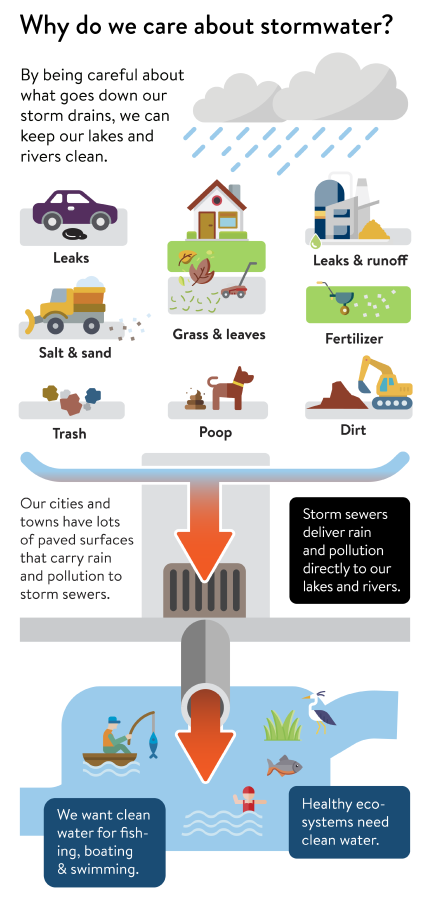
Stormwater runoff can change natural hydrologic patterns, accelerate stream flows, destroy aquatic habitats, and elevate pollutant concentrations and loadings. Development substantially increases impervious surfaces thereby increasing runoff from city streets, driveways, parking lots, and sidewalks, on which pollutants from human activities settle.

Aerial photo of urban storm-water runoff in Minnesota - Photo by Todd Smith, MPCACommon pollutants in runoff include pesticides, fertilizers, oils, metals, pathogens, salt, sediment, litter and other debris are transported via stormwater and discharged - untreated - to water resources through storm sewer systems.

The Stormwater Program for MS4s is designed to reduce the amount of sediment and pollution that enters surface and ground water from storm sewer systems to the maximum extent practicable. Stormwater discharges associated with MS4s are regulated through the use of National Pollutant Discharge Elimination System (NPDES) permits. NPDES permits are legal documents. Through this permit, the owner or operator is required to develop a stormwater pollution prevention program (SWPPP) that incorporates best management practices (BMPs) applicable to their MS4. See the following fact sheet for additional information:

What is an MS4

A municipal separate storm sewer system is a conveyance or system of conveyances (roads with drainage systems, municipal streets, catch basins, curbs, gutters, ditches, man-made channels, storm drains):

  • Owned or operated by a state, city, town, borough, county, parish, district, association, or other public body (created by or pursuant to State law) having jurisdiction over disposal of sewage, industrial wastes, stormwater, or other wastes, including special districts under State law such as a sewer district, flood control district or drainage districts, or similar entity, or an Indian tribe or an authorized Indian tribal organization, or a designated and approved management agency under section 208 of the Clean Water Act that discharges to waters of the United States;
  • Designed or used for collecting or conveying stormwater;
  • Which is not a combined sewer; and
  • Which is not part of a publicly owned treatment works.

Types of small MS4s

There are three categories of regulated small MS4s: mandatory, designated and petition. Small MS4s include municipalities, townships, counties, military bases, hospitals, prison complexes, highway departments, and universities.

  1. Mandatory MS4s: MS4s in urbanized areas as defined by the 2000 Census are required to obtain a NPDES/SDS stormwater permit. An "urbanized area" is defined as a land area comprising one or more places (“central places”) and the adjacent densely settled surrounding area (“urban fringe”) that together have a residential population of at least 50,000 and a density of at least 1,000 people per square mile. The definition also includes any other public storm sewer system located fully or partially within an urbanized area.

    The following list identifies Minnesota’s mandatory small MS4 cities, townships, and counties. The list also includes non-traditional mandatory MS4s identified by MPCA staff as requiring permit coverage. Non-traditional MS4s are publicly owned systems at military bases, hospitals, prisons, universities, highways and other thoroughfares.

Note: The cities of Minneapolis and St. Paul received individual stormwater permits in 2000.

  1. Designated MS4s:  MS4s outside of urbanized areas that have been designated by the MPCA for permit coverage under Minn. R. ch 7090 are required to obtain a NPDES/SDS stormwater permit. MS4s designated by rule are cities and townships with a population of at least 10,000; and cities and townships with a population of at least 5,000 and discharging or the potential to discharge to valuable or polluted waters. These designated MS4s are required to obtain permit coverage by February 15, 2007.

The rules also establish criteria that can be applied to designate future MS4s under a designation process identified in the rule. Visit the Stormwater Program Rulemaking Web page for details.

  1. Petition MS4s:  MS4s that are designated through the petition process under Minn. R. ch. 7090 are required to obtain a NPDES/SDS stormwater permit. The public can petition the Commissioner for the designation of an MS4 based on the designation criteria established in the rules. Visit the Stormwater Program Rulemaking Web page for details.

Maps of MS4s

MS4 mapping tool

  • MS4 mapping tool: This is an electronic map tool using Geographic Information Systems (GIS) technology.
    Note: This is best viewed using Internet Explorer 5.0 or higher or Netscape 6.0 or higher, with pop-up blockers disabled and screen resolution set to 1024x768 or higher. Minnesota Map showing regional areas for Mandatory MS4s

Mandatory MS4s

Note: The maps above for Duluth, Minneapolis/St. Paul and St. Cloud areas are interactive.  Once you've opened one of those maps, click on a numbered area within the grid on the map to open a new map showing details of the grid area.

Designated MS4s

Maps of MS4s designated under the Minnesota Rules Chapter 7090 are available on the Stormwater Program Rulemaking Web page.

Special waters and impaired waters

The MS4 General Permit for MS4s near specially-protected waters require additional controls, conditions or an individual permit:

  • MS4s that discharge near waters with qualities that warrant extra protection (special waters) must use additional best management practices and enhanced runoff controls (see permit Part IX).
  • MS4s that discharge near an “impaired water” for which there is a total maximum daily load (TMDL) allocation for stormwater sources must meet special conditions (see permit Part IV.D).

The MPCA has several documents and an interactive map called Special Waters Search to help owners and operators of MS4s identify those waters near their MS4 that may require extra protections or an individual permit. The specific requirements are outlined in the MS4 General Permit.

Permit

MS4 permit requirements

MS4s are required to develop and implement a stormwater pollution prevention program (SWPPP) to reduce the discharge of pollutants from their storm sewer system to the maximum extent practicable. The SWPPP must cover six minimum control measures.

The MS4 must identify best management practices (BMPs) and measurable goals associated with each minimum control measure. An annual report on the implementation of the SWPPP must be submitted each year.

Public process for SWPPPs

The MPCA will provide public notice and opportunity for public comment and hearing on each MS4s proposed SWPPP. Information on the public notice process is available at the MPCA Web page Public Notice Process for MS4 General Permit Applications.

Permit and program forms

Permit/Application

Summary

Fact Sheets and Instructions

PDF Document 2013 Reissuance of the General NPDES/SDS Permit MNR040000 for Municipal Separate Storm Sewer Systems (MS4s) (wq-strm4-59k)


PDF Document 2006 Reissuance of the General NPDES/SDS Permit MNR040000 for Municipal Separate Storm Sewer Systems (MS4s) (wq-strm4-51)

The new permit (MNR040000) becomes effective on August 1, 2013.


Application Items

Summary

Fact Sheets and Instructions

MS Word Document MS4 SWPPP Application for Reauthorization (SWPPP Document) (PDF Version) (wq-strm4-49a)

Application for Reauthorization

PDF Document MS4 SWPPP Application for Reauthorization (SWPPP Document) Example (wq-strm4-49b)
MS Excel Document MS4 Permit TMDL Attachment Spreadsheet (wq-strm4-49c)

Application supplement for MS4s with approved TMDL with a Waste Load Allocation (WLA) prior to the effective date of Permit.

PDF Document Guidance for MS4 TMDL Requirements (wq-strm4-49f)


MS Excel Document Master List MS4 Permit TMDLs Spreadsheet (PDF Version) (wq-strm4-49d)
MS Excel Document MS4 Pond, Wetland and Lake Inventory Form (PDF Version) (wq-strm4-30)

Application supplement; inventory of all ponds, wetlands and lakes within permittee’s jurisdiction.

Must be submitted within 24 months of the date permit coverage is extended.


MS Word Document Alum or Ferric Chloride Phosphorus Treatment Systems Form (PDF Version) (wq-strm4-49e)

Application supplement for MS4s with alum or ferric chloride phosphorus treatments systems.

Must be submitted within 12 months of the date permit coverage is extended.


Additional Items

Summary

Fact Sheets and Instructions

MS4 Annual Reports

Annual Reports are due June 30 of each year.

Use SWPPP Pollution Prevention Guidance on the right. To update your current SWPPP to reflect changes in needs or when completing Annual Reports to aid in assessment of appropriateness of identified BMPs.

PDF Document MS4 Inspection and Recordkeeping (wq-strm4-05)


PDF Document SWPPP Pollution Prevention Guidance (wq-strm4-26)

MS Excel Document Summary of Stormwater Pond Sediment Testing Results (wq-strm4-79)


Construction Stormwater General Permit

Use these forms to to meet permit requirements for stormwater pond dredging for maintenance purposes.

PDF Document Managing Stormwater Sediment Best Management Practice Guidance for Municipalities (wq-strm4-16)

Guidance and BMPs

Guidance and fact sheets

Best management practices

General

Pollution prevention/good housekeeping

Illicit discharge, detection and elimination

Stormwater Financial Assistance

The MPCA has various opportunities for receiving grants or loans for stormwater projects in Minnesota. Visit the following MPCA Web pages for information on water-related financial assistance:

Contacts

For more information regarding the MS4 Stormwater Program, please contact the following staff. If outside the metro area, please call 1-800-657-3864.

Supervisor:

Marni Karnowski, 651-757-2495

Permit writer:

Duane Duncanson, 651-757-2323

Technical assistance:

Scott Fox, 651-757-2368
Claudia Hochstein, 651-757-2881
Cole Landgraf, 651-757-2880
Dan Miller, 651-757-2246
Rachel Stangl, 651-757-2879

TMDL/MS4 Permit technical assistance:

Anna Kerr, 651-757-2488

Compliance/enforcement:


Marni Karnowski, 651-757-2495

Application processing

Wendy Gardner-Pritchard, 651-757-2090

Last modified on June 11, 2013 14:07