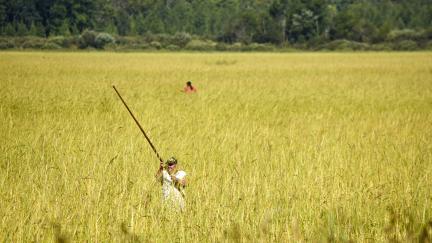
Wild rice is an important part of the biological community in many Minnesota lakes, streams, and wetlands. Wild rice is also a cultural resource to many, particularly members of the Dakota and Ojibwe Tribal Nations in Minnesota, and it is an important economic resource to those who harvest and market it. Minnesota recognizes wild rice as its official state grain.
Wild rice is found primarily in low-sulfate waters. Sulfate is a naturally occurring chemical and can also be found in discharges from mining operations, wastewater treatment plants, and industrial facilities.
The MPCA is currently working to fully implement a water quality standard to protect wild rice from excess sulfate. The standard, 10 mg/L sulfate, which was adopted in 1973, applies to “waters used for production of wild rice.” The agency is also working with permittees, researchers, Tribal partners, other levels of government, as well as the public to investigate ways to protect wild rice.
History
The MPCA has sponsored studies on how sulfate affects wild rice. Research projects in 2012-2013, including a field survey, laboratory experiments, and mesocosm (outdoor growth tank) experiments, helped to inform a 2017 proposal to amend the existing sulfate water quality standard. This rulemaking attempt was ultimately unsuccessful. Consequently, the 1973 sulfate water quality standard remains in effect. MPCA is committed to implementing this standard.
Implementation
The 10 mg/L sulfate water quality standard is designed to protect wild rice and applies in specific waters called “waters used for production of wild rice” (Minn. R. 7050.0224).
Where the standard applies. The MPCA has developed a list of approximately 2,400 waters used for production of wild rice. This list was developed from multiple sources of information — biological monitoring data, survey databases, and various inventories — to determine where the wild rice beneficial use has been, or could be, attained.

Wild rice waters
This online search tool will assist in identifying wild rice waters and in identifying facilities that require a permit review because they are located in a watershed upstream or partially upstream of such waters.
NPDES/SDS permitting
The MPCA is continuing to work with permittees, the public, and state, local, federal partners, and Tribal Nations to develop ways to protect this important Minnesota resource through implementation of the long-standing 10 mg/L sulfate standard via monitoring, assessment, and permitting.
- The MPCA held an informational meeting (May 24, 2023) for representatives of NPDES/SDS permitted facilities, to discuss where the standard applies and how the standard would be considered in NPDES/SDS permits.
- In a follow-up meeting (June 28, 2023) we discussed options if a facility can’t meet a permit limit and the framework for developing site-specific sulfate standards to protect waters used for production of wild rice.
- In the final meeting in the series (Sept. 27, 2023), MPCA staff responded to NPDES/SDS permit-related questions received during the feedback periods, and leaders from the University of Minnesota Duluth Natural Resources Research Institute provided information about their sulfate treatment technology research.
Impaired waters
In the 2024 Impaired Waters List, MPCA identified a total of 43 waterbodies (56 assessment units) as impaired due to measured sulfate levels in excess of 10 mg/L.
Site-specific standards
More information
- Johnson, N. W., Pastor, J., & Swain, E. B. (2019). Cumulative sulfate loads shift porewater to sulfidic conditions in freshwater wetland sediment. Environmental Toxicology and Chemistry, 38(6), 1231-1244. https://doi.org/10.1002/etc.4410.
- LaFond-Hudson, S., Johnson, N. W., Pastor, J., & Dewey, B. (2018). Iron sulfide formation on root surfaces controlled by the life cycle of wild rice (Zizania palustris). Biogeochemistry, 141(1), 95-106. https://doi.org/10.1007/s10533-018-0491-5.
- LaFond‐Hudson, S., Johnson, N. W., Pastor, J., & Dewey, B. (2022). Sulfur geochemistry destabilizes population oscillations of wild rice (Zizania palustris). Journal of Geophysical Research: Biogeosciences, 127(8), e2022JG006809. https://doi.org/10.1029/2022JG006809.
- Moyle, J. B. (1944). Wild rice in Minnesota. Journal of Wildlife Management, 8(3), 177–184. https://doi.org/10.2307/3795695.
- Myrbo, A., Swain, E. B., Engstrom, D. R., Coleman Wasik, J., Brenner, J., Dykhuizen Shore, M., Peters, E. B., & Blaha, G. (2017). Sulfide generated by sulfate reduction is a primary controller of the occurrence of wild rice (Zizania palustris) in shallow aquatic ecosystems. Journal of Geophysical Research: Biogeosciences, 122(11), 2736-2753. https://doi.org/10.1002/2017JG003787.
- Pastor, J., Dewey, B., Johnson, N. W., Swain, E. B., Monson, P., Peters, E. B., & Myrbo, A. (2017). Effects of sulfate and sulfide on the life cycle of Zizania palustris in hydroponic and mesocosm experiments. Ecological Applications, 27(1), 321-336. https://doi.org/10.1002/eap.1452.