http://www.pca.state.mn.us

tinyURL : mvri913 | ID : 485Home   >   Water   >   Permits and Rules   >   Water Permits and Forms

main content

Vessel Discharge (Ballast Water) Program

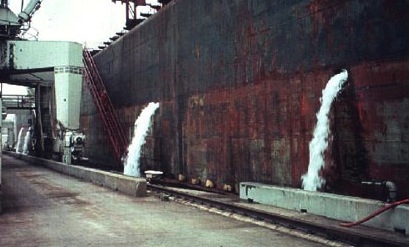
Vessel discharging ballast waterVessel discharging ballast water (Photo courtesy of L. David Smith, Smith College, MA)

Update — February 2013

The MPCA has sent letters to vessel owners holding a ballast water discharge permit, notifying them that the current general discharge permit is expiring. The letter describes the time lines and procedures for permittees to submit permit applications. For permittees applying for a new or reissued ballast water discharge permit, complete the following forms:

  • MS Word Document Ballast Water General Permit — Application Form (wq-s8-02)  If a Ballast Water and Sediment Management Plan (Plan) has previously been approved by the MPCA and has not been modified since approval, Permittees may include a statement in a cover letter to the permit application stating the date of the previously submitted Plan and stating that the Plan does not require revisions instead of submitting a new copy.
  • MS Word Document Permit Application Checklist for Miscellaneous Waste Types (wq-wwprm7-04c)
  • It is not necessary to complete the Water Quality Transmittal Form.

An error was found in the MPCA Water Quality 401 certification of the U.S. Environmental Protection Agency’s draft VGP2. The units for salinity were described as “part-per-trillion” instead of “parts-per-thousand." This error was corrected by resubmitting the letter with the corrected units to the EPA. (Corrected letter to be posted shortly.)

Update — December 2012

The Informational presentation to the MPCA Board scheduled for January 29, 2013 has been cancelled. MPCA staff anticipates that a future date will be set to update the Board on the reissuance of the ballast water general permit. Once the US Environmental Protection Agency has issued the final draft of their ballast water general permit, scheduling for the meeting will be determined.

On November 13, 2012, the State of Minnesota Court of Appeals released an opinion affirming the MPCA's decision regarding the final section 401 certification.  A document has been filed by the Minnesota Court of Appeals in Case No. A12-1661.  View this document on the Minnesota Court of Appeals website.

Update — November 2012

MPCA staff will be presenting an informational item to the MPCA Citizens' Board on January 29, 2013. Staff will discuss the status of the current ballast water general permit and take questions on the reissuance of the permit from Board members. The time of the information item has not yet been determined, but will be posted on the web page as soon as it is scheduled.

Update — October 2012

The current ballast water general permit expires September 24, 2013 and the MPCA has initiated review of the current regulatory program put in place to control the introduction and spread of invasive species. The following file contains the full announcement: PDF Document MPCA Staff Begins State Ballast Water General Permit (MNG30) Review.

The MPCA encourages public participation as staff  begin review the current nationwide regulatory program put in place since the issuance of the state general ballast water permit. Persons interested in receiving notice of meetings and updates on activities can contact Beth Gawrys at 651-757-2380 or other listed staff.

At the federal level, U.S.Environmental Protection Agency public noticed a new draft Vessel General Permit in November 2011. The final EPA general permit is scheduled for December 2012.  As required by the Clean Water Act, the EPA requested that the MPCA submit a Section 401 certification for its proposed vessel discharge general permit.

The MPCA submitted its 401 certification to the EPA in a letter dated September 7, 2012: PDF Document 401 certification letter. The MPCA's 401 certification has been challenged. For more details, see the following file: PDF Document 401 certification challenge.

Minnesota’s Discharge Permit

The MPCA issued a ballast water discharge general permit on September 24, 2008, covering the ballast water discharges of commercial vessels that transit the Minnesota waters of Lake Superior. The permit covers both seagoing and Great Lakes-only vessels.

List of Vessels with Permit Coverage

This spreadsheet contains the names of the vessels that have applied for and received coverage under the state ballast water discharge general permit:

PDF Document Vessels Covered by Ballast Water General Permit (wq-s8-04)


Other information about the vessel such as its owner and operator, geographic area of service, and its ballast water capacity is also contained in the spreadsheet.

Disclaimer. Although the MPCA makes every attempt to ensure that the information placed on this Web site is accurate and current, this site may not contain all of the vessels issued coverage under the permit by the MPCA. All ballast water permit applications and related documents are available for inspection at the MPCA's Duluth office, located at 525 Lake Avenue South, Suite 400, Duluth, MN 55802.

Permit-related Documents

Overview

The Great Lakes water transportation industry is vitally important to Minnesota’s economy. However, ballast water discharges from oceangoing and Great Lakes-only (“laker”) vessels may contain aquatic invasive species. Aquatic invasive species compete with native species for food and habitat, alter aquatic ecosystems, and cause significant economic impact. The MPCA, working with other state, federal, tribal and international organizations, is taking steps to address this threat and intends to develop a regulatory program to control the introduction and spread of invasive species by ballast water.

What are Vessel Discharges?

During the normal course of ship operations, ballast water is taken on or discharged by ships to accommodate changes in the weight of the ship due to fuel loading and use, loading and unloading of cargo, and to increase the stability of a ship due to adverse weather conditions. Ballast water uptake and discharge typically occurs at port operations, but also can occur during transit between ports.

Vessels also have other discharges such as deck runoff, bilge water (water that collects in the lowest part of the ship’s hull and may contain oil, grease, and other contaminants), water from water cooling and fireman systems, chain locker effluent, and gray water (waste water from showers, sinks, and kitchens). Sewage discharges from ships are currently regulated under federal rules. Of these discharges, ballast water by far is the greatest in volume.

Why the Need for Control?

Ballast water discharges may contain aquatic invasive species (AIS) that could survive in their new location, upsetting the local aquatic ecosystem. The Great Lakes are now home to more than 160 non-native species, with some, such as the zebra mussel and round goby, causing millions of dollars in damages.

Neither federal ballast water management requirements nor shipping practices have been effective in preventing biological invasions of the Great Lakes. Additional controls are needed to prevent the introduction of new invasive species to Lake Superior.

Ballast water brings unwanted species

This graphic demonstrating how ballast water may transfer unwanted aquatic species is for illustrative purposes only. © Ray Grumney Star Tribune March 26, 2008. Republished with permission.

MPCA Role

Due to the serious environmental and economic impacts of this issue and the uncertain timeframe associated with the federal regulatory strategy for vessel discharges, the MPCA has developed a regulatory program for ballast water discharges from vessels.

Protecting Lake Superior from aquatic invasive species is an agency priority because of the lake’s exceptional recreational, cultural, aesthetic, and scientific resource value as an Outstanding Resource Value Water. It also helps prevent the inadvertent spread of aquatic invasive species to Minnesota lakes and rivers by boaters.

MPCA Actions

Since the mid-1990s, Minnesota state government agencies, particularly the Department of Natural Resources, have been working to prevent the spread of AIS using a regional approach.

In 2007, the MPCA joined with the DNR to address this issue spurred by a Federal District Court ruling in late 2006 that vacated federal exemptions of vessel discharges from NPDES permitting as of September 30, 2008. See the PDF Document Federal District Court ruling file for more information.

In April 2008, Minnesota's Ramsey County District Court affirmed the MPCA's schedule for issuing a vessel discharge permit by September 30, 2008. See the Ramsey District Court decision for more information.

In May 2008, the Minnesota Legislature passed S.F. 3056, which contains language related to ballast water management beginning at line 19.23. The legislation, effective on July 1, 2008, specifies requirements related to ballast water management and ballast water record books. The MPCA's general permit will reflect the requirements in the legislation.

The state general permit requires that vessels built prior to January 1, 2012, have installed and operational ballast water treatment systems by January 1, 2016. For vessels constructed after January 1, 2012, ballast water treatment systems must be installed and operational prior to commencement of operation in Minnesota state waters of Lake Superior.

These actions help establish controls to prevent the spread of aquatic invasive species by vessels and meet the state’s pending vessel discharge regulatory strategy:

  • Vessel Discharge Permit. On September 24, 2008, the MPCA issued a general permit for commercial vessels that discharge ballast water into Lake Superior and its harbors. In October 2008, the State Court of Appeals was asked to review some aspects of the permit. See the PDF Document permit challenge for more information.
  • Participating in Federal Regulatory Efforts. The MPCA supports ongoing federal efforts to further control vessel discharges in a manner that is protective of Lake Superior and the Great Lakes as a whole. A federal approach to regulating vessel discharges would provide a consistent framework for regulatory programs.
  • Coordination with Other Organizations. The MPCA is committed to working with organizations and agencies that have an interest and role in supporting actions to prevent the spread of AIS. These groups include the Minnesota DNR, the U.S. Coast Guard, the U.S. Environmental Protection Agency, shipping industry associations, the St. Lawrence Seaway Development Corporation, port authorities, local governments, environmental organizations, and international organizations.

Federal Regulatory Efforts

On March 30, 2005, the Federal District Court in Northern California issued a ruling that the EPA had exceeded its statutory authority when, more than 30 years ago, the EPA issued a regulation excluding “discharges incidental to normal operation of a vessel at 40 CFR 122.3(a)” from Clean Water Act NPDES permit requirements.

On September 18, 2006, the Court issued an order vacating the regulation as of September 30, 2008. The Court delayed vacatur by two years to allow the EPA time to address the ramifications of the vacatur. The EPA challenged the decision and in July, 2008, the U.S. Court of Appeals for the Ninth District upheld the lower court’s decision declaring the earlier exemption unlawful and requiring EPA to develop a permit program by September 30, 2008. In late August 2008, the Court granted EPA an extension until December 19, 2008, for issuance of the permit. On December 17, 2008, the Court extended the vacatur of the vessel discharge exemption until February 6, 2009. The EPA issued a national permit on December 18, 2008.

In 2007 and 2008, federal legislators have introduced bills to regulate ballast water. The U.S. House passed HR 2830, titled the Coast Guard Authorization for 2008. Title V of the legislation, which would be called the Ballast Water Treatment Act of 2008, establishes a “national goal that ballast water discharged into the waters of the United States will contain no living (viable) organisms by the year 2015” and a “national policy that the introduction of nonindigenous aquatic nuisance species in the waters of the United States be prohibited.” Action by the U.S. Senate is pending.

Resources

Federal

State-based

Great Lakes

Other

HTML Content Ballast Water Management (International Maritime Organization) External Link

More Information

  • Beth Gawrys, Ballast Water Permit Coordinator, 651-757-2380
  • John Thomas, Permit Compliance, 218-302-6616
  • Jeff Udd, Water Quality Permits Supervisor, 218-302-6637
  • Jeff Stollenwerk, Water Quality Permits and Compliance Manager, 218-302-6612
Last modified on March 01, 2013 09:28