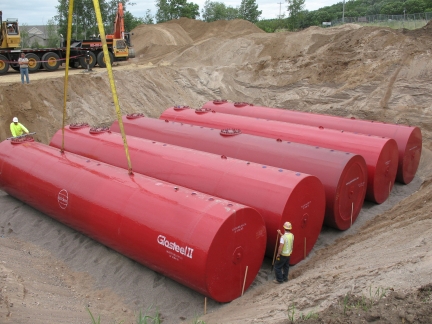
In Minnesota, about 18,000 regulated underground storage tanks (UST) are in use. State rules specify requirements for USTs that store petroleum or hazardous substances, and any piping or other structures that are part of the tank systems.
Some types of underground tanks are exempt from state regulations:
- tanks with capacity of 110 gallons or less
- farm and residential tanks with a 1,100 gallon capacity or less, storing motor fuel for non-commercial purposes, or heating oil for on-site consumption
- new fuel oil or waste oil tanks used solely for on-premises heating are subject to notification and corrosion protection requirements:
- new fuel oil or waste oil tanks used solely for on-premises heating are subject to notification and corrosion protection requirements:
- tanks that contain a minimum concentration of regulated substances
- flow-through process tanks
- oil-water separators
Design and operating requirements for regulated USTs include tank and piping corrosion protection, overfill prevention, dispenser and pump containment, cathodic protection system testing, release detection, and more.

Contractors for UST work
Tank owners must use MPCA-certified contractors to install or service underground tanks.
New or replacement installations
Tank owners must notify the MPCA at least 10 days before installing or replacing a UST system or component. The work must be overseen by a certified contractor and comply with applicable codes.
Owners must also submit a post-installation notice to the MPCA with 30 days of completion:
Secondary containment
All new and replacement UST systems (tank, piping, submersible pumps, dispensers) must have secondary containment with interstitial monitoring, except for heating oil tanks and piping, and safe suction piping.
Dispensers and submersible pumps
Secondary containment must be installed under new and replacement dispensers and surrounding submersible pump heads to contain leaks. The containment must be made of synthetic materials (not metal or concrete) and its sides, bottom, and points where pipes penetrate must be liquid-tight. Dispenser containment is not required when a dispenser is replaced and no work is performed beneath the shear valve. Containment is also required when the concrete or base material beneath the dispenser is replaced, or if new or replacement piping is connected to the dispenser.
Spill and overfill prevention
Tanks must have a liquid-tight spill bucket surrounding the fill pipe, to catch spills that may occur when the delivery hose is disconnected from the fill pipe. Spill buckets must be kept clear of debris and stormwater, and spilled product must be removed. Fill pipes must have a drop tube. Tanks also must have an overfill prevention device, such as an automatic shutoff device (flapper valve), high level alarm, or a flow restrictor device in a vent line. Existing ballfloat devices are allowed if they function properly, but can't be installed or repaired going forward.
UST compatibility with stored product
UST systems must be compatible with the product they store and dispense. Submit both the UST change in status form and UST alternative fuel compatibility form at least 30 days before storing fuel made of greater than 10% ethanol or 20% biodiesel.
Management requirements
There are main six requirements for managing USTs:
- tank leak detection
- line (pipe) leak detection
- corrosion protection
- tank maintenance testing
- recordkeeping
- operator training
Release detection
Tanks
Tank owners must have a system for detecting leaks from any part of the tank, piping, pumps, and dispensers. Systems must either be monitored continuously or checked for leaks every 30 days.
Tanks installed after Dec. 22, 2007, must be double-walled with interstitial monitoring as the primary method of tank leak detection. Acceptable release detection methods for tanks installed prior to Dec. 22, 2007:
- automatic tank gauging
- statistical inventory control (SIR)
- manual gauging, for tanks of less than 1,000 gallon capacity
- interstitial monitoring (secondary containment tanks)
NOTE: As of October 2020, USTs used for emergency power generation on-premises, or for both emergency power and heating (dual-use), must implement a tank and piping release detection method if one isn't already in place.
Learn more:
Piping
All pressure piping must have an automatic line leak detector (mechanical or electronic) that can detect a leak of three gallons per hour at 10 psi line pressure within an hour. Automatic line leak detectors must be tested annually to ensure they are working properly.
Pressurized piping installed after Dec. 22, 2007, must be double-walled, with interstitial monitoring performed continuously or monthly. Pressurized piping installed prior to Dec. 22, 2007, must use one of the following:
- annual line tightness testing at 0.1 gallons per hour by an MPCA-approved tester.
- monthly line tightness testing at 0.2 gallons per hour (electronic line leak detector or SIR).
- continuous or monthly interstitial monitoring (for double wall pipe systems).
Release detection is not required for properly designed "safe suction" piping. Other suction piping must use line tightness testing every three years, monthly SIR, or continuous or monthly interstitial monitoring (for double wall pipe systems).
Learn more:
Corrosion protection
Tank and piping design must include corrosion protection to prevent degradation and rusting of metal components.
Cathodic protection
Cathodic protection systems protect metallic UST system components buried in soil from corrosion. Two types of cathodic systems are commonly used on UST systems: impressed current and sacrificial anode.
Cathodic systems must be properly maintained and tested periodically to ensure effectiveness. Sacrificial anode systems must be tested every three years, and impressed current systems every year, by a qualified service providers. Cathodic protection system test results must be submitted to the MPCA within 30 days:
Details on cathodic protection installation, testing, and repair:
Internal lining inspections
USTs where an internal lining is the sole method of corrosion protection must be internally inspected every five years.
Inspections and testing
Monthly walk-through inspections
These monthly requirements, effective in 2019, may be conducted by the tank owner or operator:
- All spill buckets, dispenser sumps, and submersible pump sumps must be visually checked for leaks. Any product, water, and debris must be cleaned out. The source of any leaks must be immediately investigated and repaired.
- A submersible pump sump with secondary containment and an automatic leak sensor only needs to be checked annually, provided the leak sensor is function-tested annually as well. Check that all riser caps are tight and no obstructions are in the fill port (drop tube).
- Ensure release detection equipment is operating with no alarms or unusual operating conditions, and review and update release detection records.
- Ensure the tank bottoms are monitored for water, and the source of water is investigated. Removing water from the tank is very important.
An inspection form helps with these requirements:
Annual release detection operability
Testing mechanical and handheld release detection components is required to assure serviceability and proper operation. The annual testing described below must be conducted by an agency-approved tester:
- Test automatic tank gauge controllers, alarms, and system configuration
- Test probes, sensors, and automatic line leak detectors for functionality and communication with controller
- Vacuum pumps and pressure gauges must have proper communication with sensors and controllers
- Hand-held release detection devices (gauging sticks and fuel paste) are functional
- Visually inspect all spill buckets and containment sumps used for interstitial monitoring for liquid tightness and deficiencies
Inspection forms for these requirements:
Three year functionality and integrity testing
Functionality and integrity testing must be done every three years by an agency-approved tester, and include:
- an integrity test on all spill buckets and containment sumps used for interstitial monitoring, to assure liquid tightness.
- Double-wall spill buckets or containment sumps used for interstitial monitoring are exempt from three year integrity testing, provided the interstice is checked monthly for liquid, and leak sensing devices are checked annually for proper function.
- interstitial monitoring on pressure piping and non-safe suction piping installed after December 22, 2007.
- overfill protection devices checked to ensure activation at the correct level and proper function.
Inspection forms for these requirements:
Annual or three year testing and inspections must be conducted by MPCA-approved testers. Learn how to become an agency-approved tester:
Recordkeeping
The MPCA requires tanks owners to keep records demonstrating their compliance with tank rules. Some records regarding installation, repairs, compatibility, and use of alternative methods must be retained for the life of the tank system. Other records such as release detection and operation and maintenance testing must be retained for five years.
Temporary and permanent closure
Tank owners are subject to requirements for inactive tanks (temporary closure) or tanks out of service permanently (permanent closure):
The MPCA encourages you to contact your local government unit and fire code official, which may require permits or have additional requirements for UST closures.
Vapor recovery for metro gasoline USTs
All retail locations selling gasoline to automobiles in the Twin Cities seven-county metro area must have Stage 1 vapor recovery equipment installed on their underground tanks. Vapor recovery equipment captures vapor emitted during the transfer of gasoline from the delivery vehicle to the tank, and routes it back to the tanker.